Totes for growers
By unit count, agriculture is our largest customer group — and the one with the sharpest seasonal peaks. Here is what the sector actually buys, what it gets wrong, and where leasing beats owning.
Quote for a farm or co-op
Tell us the input, the quantity and whether you have a forklift. Seasonal lease floats quoted alongside purchase.
Tell us what you have.
We will tell you what it is worth.
Buying, selling, washing, hauling or recycling — one form covers all of it. Replies come from a specialist in York, PA, by email, inside one business day.
Prefer plain email? Write to info@ibctotesreco.com — include your ZIP, quantity and what the totes last held.
Growers buy mostly Grade B and Grade C reconditioned 275-gallon totes: Grade B for liquid fertiliser, UAN and crop protection; Grade C for irrigation buffer, livestock water and site storage. Anything edible — maple sap, honey, cider — needs food-grade or rebottled stock. The rule that costs farms money when broken: a fertiliser-prior tote is never potable or food eligible again.
Two populations, never mixed
The most valuable thing a farm can do with its tote fleet is split it in two and mark it permanently. One population for inputs — fertiliser, crop protection, adjuvants, fuel. One for water and edibles — irrigation buffer, livestock water, sap, wash water.
Totes migrate. They get borrowed in a busy week, moved by a different person, and six months later nobody can tell which is which. Stencil the cage, use coloured lids, keep them in separate rows — whatever works, as long as a tired person at 5 AM in April cannot get it wrong. We will stencil to order before dispatch at no charge if you tell us how you want it marked.
What the sector buys, season by season
February–April: maple sap. Food-grade or rebottled, vented lids, almost all leased. Peak demand is brutal and brief, and the producers who plan it in November get the stock.
March–June: liquid fertiliser and starter. Grade B, 275 and 330 gallon, bought outright and kept. The single biggest volume window of our year.
May–September: crop protection, adjuvants, foliar feeds. Grade B with the elastomer specified against the actual product — some adjuvants attack EPDM.
June–October: irrigation buffer and livestock water. Grade C, and the best-value container in the whole catalogue for this duty.
August–November: cider, wine, honey. Food-grade or rebottled, frequently leased for the crush and returned.
November–March: de-icer for farm roads and yards, and empty totes sold back to us in the quiet months.
Where leasing wins on a farm
Anything with an eight-to-twelve week window. Sap, crush, a single spray programme. You pay for the weeks you use the containers instead of storing them for nine months and washing them in the spring, and they go straight into another producer's season when you hand them back — how the lease pool works.
Common farm inputs and what they do to a tote
The right-hand column is the one that matters long term.
| Product | SG | 275 gal filled | Seal | Food-grade after? |
|---|---|---|---|---|
| UAN 32 liquid nitrogen | 1.32 | 3,054 lb | EPDM | No, permanently |
| Liquid starter (10-34-0) | 1.38 | 3,187 lb | EPDM | No, permanently |
| Potassium thiosulphate | 1.47 | 3,386 lb | EPDM | No, permanently |
| Humic / fulvic acid | 1.10 | 2,569 lb | EPDM | No |
| Glyphosate concentrate | 1.17 | 2,724 lb | EPDM / Viton | No, permanently |
| Foliar micronutrient | 1.25 | 2,901 lb | EPDM | No |
| Crop oil adjuvant | 0.88 | 2,083 lb | Viton | No |
| Irrigation water | 1.00 | 2,347 lb | EPDM | Yes, if prior service allows |
| Livestock drinking water | 1.00 | 2,347 lb | EPDM | Yes, if prior service allows |
| Maple sap | 1.02 | 2,392 lb | FDA EPDM | Yes |
| Honey | 1.42 | 3,275 lb | FDA EPDM | Yes |
| Apple cider | 1.05 | 2,457 lb | FDA EPDM | Yes |
| Calcium chloride (road) | 1.38 | 3,187 lb | Viton | No |
| Diesel / off-road fuel | 0.85 | 2,013 lb | Viton | No, permanently |
Everything in that last column marked “permanently” means the container is an inputs tote for the rest of its life. That is not a problem — it is just a decision you make once, at purchase, rather than discovering in a year when you need a water tank.
Agriculture FAQ
Can I use a fertiliser tote for drinking water or vegetables later?
No, and this is the single most important thing on this page. A container that held liquid fertiliser or any crop protection product is never food-grade or potable eligible again, regardless of how it is washed. Keep two populations on your farm — one for inputs, one for water and edibles — and mark them so nobody mixes them up in February.
What grade do I need for UAN 32 or liquid starter?
Grade B reconditioned, with EPDM seals, is the standard answer and excellent value. UAN rinses readily, so prior-UAN totes are easy for us to turn around and cheap for you to buy. Note the density: UAN 32 at SG 1.32 makes a filled 275-gallon tote about 3,050 lb, so check your handling ratings.
Are IBC totes any good for maple sap?
They are the backbone of mid-sized sugaring operations. You want food-grade or rebottled units, a vented lid, and a plan for washing between seasons — sap sugars and the resulting microbial film need a hot detergent cycle, not a cold rinse. Most producers lease rather than buy because the season is eight weeks long.
Will a tote survive being left in a field year-round?
A few seasons, declining. UV is what destroys a poly bottle, and a bottle in full sun in an open field chalks and stiffens noticeably within two or three years. Shade it, cover it or paint the cage-side with a light-coloured tarp and you will double or triple that. Never leave one full and sealed through a hard freeze.
Can I get them delivered to a farm without a dock or forklift?
Yes — tell us on the form and we will quote a flatbed with its own lift or a lift-gate truck. It changes the price and the window, so it matters that we know before dispatch rather than when the driver is at the end of your lane looking at a cattle grid.
Related pages
Agricultural inputs and water, in full
Specific gravity, wash programme, achievable grade, seal material and whether the container can ever be food-eligible again.
| Prior product | Family | SG | Programme | Best grade | Food? | Seal | What to watch |
|---|---|---|---|---|---|---|---|
| UAN 32 liquid nitrogen | Agricultural | 1.32 | P1 | B | Never | EPDM | Rinses readily; dense — check ratings |
| UAN 28 | Agricultural | 1.28 | P1 | B | Never | EPDM | As above |
| Liquid starter 10-34-0 | Agricultural | 1.38 | P1 | B | Never | EPDM | Polyphosphate scale at the outlet |
| Ammonium thiosulphate | Agricultural | 1.33 | P1 | B | Never | EPDM | Sulphur odour persists faintly |
| Potassium thiosulphate | Agricultural | 1.47 | P1 | B | Never | EPDM | Very dense; 275 format only |
| Calcium nitrate solution | Agricultural | 1.43 | P1 | B | Never | EPDM | Crystallises when cold |
| Humic / fulvic acid | Agricultural | 1.10 | P2 | B | Never | EPDM | Dark staining, usually washes out |
| Fish hydrolysate fertiliser | Agricultural | 1.12 | P3 | C | Never | Viton | Odour frequently permanent |
| Foliar micronutrient blend | Agricultural | 1.25 | P1 | B | Never | EPDM | Metal salts can tint the wall |
| Glyphosate concentrate | Agricultural | 1.17 | P3 | C | Never | Viton | Labelled rinse programme governs |
| 2,4-D amine concentrate | Agricultural | 1.19 | Refused | Per label | Never | Viton | Label prescribes rinse-and-destroy |
| Crop oil adjuvant | Agricultural | 0.88 | P3 | C | Never | Viton | Attacks EPDM; permeates slowly |
| Surfactant adjuvant (NIS) | Agricultural | 1.03 | P1 | B | Never | EPDM | Foams heavily on transfer |
| Molluscicide suspension | Agricultural | 1.22 | Refused | Per label | Never | Viton | Refused — labelled destruction |
| Livestock drinking water | Water & inert | 1.00 | P1 | A | Yes | EPDM | Effectively first-use |
| Irrigation water | Water & inert | 1.00 | P1 | A | Yes | EPDM | May carry silt; coarse settling |
| Potable water | Water & inert | 1.00 | P1 | A | Yes | FDA EPDM | Frequently first-use stock |
| Deionised water | Water & inert | 1.00 | P1 | A | Yes | FDA EPDM | Best-value first-use source |
| Distilled water | Water & inert | 1.00 | P1 | A | Yes | FDA EPDM | As above |
| Glycerine, technical | Water & inert | 1.26 | P1 | B | No | EPDM | Technical grade is not food grade |
| Saline solution, industrial | Water & inert | 1.07 | P1 | B | Never | Viton | Chloride; inspect cage |
| Prior product | SG | 275 gal filled | 330 gal filled | Seal | Programme |
|---|---|---|---|---|---|
| UAN 32 liquid nitrogen | 1.32 | 3,054 lb | 3,688 lb | EPDM | P1 |
| UAN 28 | 1.28 | 2,966 lb | 3,581 lb | EPDM | P1 |
| Liquid starter 10-34-0 | 1.38 | 3,187 lb | 3,848 lb | EPDM | P1 |
| Ammonium thiosulphate | 1.33 | 3,076 lb | 3,715 lb | EPDM | P1 |
| Potassium thiosulphate | 1.47 | 3,386 lb | 4,088 lb | EPDM | P1 |
| Calcium nitrate solution | 1.43 | 3,297 lb | 3,981 lb | EPDM | P1 |
| Humic / fulvic acid | 1.10 | 2,568 lb | 3,101 lb | EPDM | P2 |
| Fish hydrolysate fertiliser | 1.12 | 2,612 lb | 3,154 lb | Viton | P3 |
| Foliar micronutrient blend | 1.25 | 2,900 lb | 3,501 lb | EPDM | P1 |
| Glyphosate concentrate | 1.17 | 2,723 lb | 3,287 lb | Viton | P3 |
| 2,4-D amine concentrate | 1.19 | 2,767 lb | 3,341 lb | Viton | Refused |
| Crop oil adjuvant | 0.88 | 2,082 lb | 2,514 lb | Viton | P3 |
| Surfactant adjuvant (NIS) | 1.03 | 2,413 lb | 2,914 lb | EPDM | P1 |
| Molluscicide suspension | 1.22 | 2,833 lb | 3,421 lb | Viton | Refused |
| Livestock drinking water | 1.00 | 2,347 lb | 2,834 lb | EPDM | P1 |
| Irrigation water | 1.00 | 2,347 lb | 2,834 lb | EPDM | P1 |
| Potable water | 1.00 | 2,347 lb | 2,834 lb | FDA EPDM | P1 |
| Deionised water | 1.00 | 2,347 lb | 2,834 lb | FDA EPDM | P1 |
| Distilled water | 1.00 | 2,347 lb | 2,834 lb | FDA EPDM | P1 |
| Glycerine, technical | 1.26 | 2,922 lb | 3,528 lb | EPDM | P1 |
| Saline solution, industrial | 1.07 | 2,502 lb | 3,021 lb | Viton | P1 |
The four decisions after the product name
Format, grade, seal and weight — in that order, because each one constrains the next.
Container formats with full dimensional data
| Format | Nominal | Usable | L × W × H | Tare (steel base) | Gross, water | Outlet | Stack filled | Availability |
|---|---|---|---|---|---|---|---|---|
| 275 gal standard | 275 gal / 1,041 L | 265 gal | 48 × 40 × 46" | 137 lb | 2,347 lb | 2" S60x6 | 2 high | Ex-stock |
| 275 gal tall | 275 gal / 1,041 L | 264 gal | 48 × 40 × 53" | 141 lb | 2,342 lb | 2" S60x6 | 2 high | Regular |
| 330 gal standard | 330 gal / 1,249 L | 320 gal | 48 × 40 × 53" | 165 lb | 2,834 lb | 2" S60x6 | 2 high | Ex-stock |
| 350 gal | 350 gal / 1,325 L | 338 gal | 48 × 40 × 58" | 172 lb | 2,991 lb | 2" or 3" | 2 high | Occasional |
| 400 gal | 400 gal / 1,514 L | 386 gal | 48 × 46 × 60" | 198 lb | 3,417 lb | 3" buttress | 1 high | Order |
| 550 gal | 550 gal / 2,082 L | 532 gal | 48 × 48 × 72" | 251 lb | 4,688 lb | 3" buttress | 1 high | Occasional |
| 120 gal mini | 120 gal / 454 L | 115 gal | 32 × 32 × 36" | 71 lb | 1,030 lb | 2" S60x6 | 2 high | Occasional |
| 180 gal | 180 gal / 681 L | 174 gal | 40 × 40 × 42" | 98 lb | 1,549 lb | 2" S60x6 | 2 high | Order |
| Stainless 265 gal | 265 gal / 1,003 L | 258 gal | 48 × 40 × 50" | 285 lb | 2,436 lb | 2" tri-clamp | 2 high | Occasional |
| Stainless 330 gal | 330 gal / 1,249 L | 322 gal | 48 × 40 × 56" | 330 lb | 3,015 lb | 2" tri-clamp | 2 high | Occasional |
| Stainless 400 gal | 400 gal / 1,514 L | 390 gal | 48 × 46 × 62" | 385 lb | 3,637 lb | 3" tri-clamp | 1 high | Order |
| Stainless 500 gal | 500 gal / 1,893 L | 488 gal | 48 × 48 × 68" | 430 lb | 4,600 lb | 3" tri-clamp | 1 high | Order |
Grade matrix — what each condition commits us to
| Grade A | Grade B | Grade C | Cage / pallet only | |
|---|---|---|---|---|
| Bottle clarity | Clear / near-clear | Haze & staining permitted | Ghosting permitted | n/a |
| Prior service | Documented edible, signed at source | Industrial, declared | Industrial, declared | Any declared |
| Wash programme | Food line, recorded | Programme to residue, recorded | Ambient rinse | Cage rinse only |
| Hydrostatic test | 100% of units | Sampled | Sampled | n/a |
| New valve & gaskets | Yes, FDA-compliant | Yes | Sound or new | n/a |
| New lid | Yes | Yes | Sound or new | n/a |
| Re-marked | Yes | Yes | Where the plate survives | No |
| Stackable when filled | 2 high | 2 high | No | n/a |
| 30-day leak warranty | Yes | Yes | No — watertight at loading | No warranty |
| Food / potable | Yes, with records | No | No | n/a |
| Cost vs new | ≈ 35–45% | ≈ 25–32% | ≈ 18–24% | ≈ 5–10% |
| Lead time | Ex-stock to 5 days | Ex-stock | Ex-stock | Ex-stock |
| Loop score (lives left) | 5–6 | 4–5 | 2–3 | 3–4 bottles |
Seal compatibility — 21 media, four elastomers
| Medium | EPDM | Viton (FKM) | Silicone | PTFE | We would fit |
|---|---|---|---|---|---|
| Water, potable & process | Excellent | Excellent | Excellent | Excellent | EPDM |
| Dilute acids (<10%) | Good | Excellent | Fair | Excellent | EPDM |
| Concentrated acids | Poor | Good | Poor | Excellent | PTFE |
| Caustic soda, alkalis | Excellent | Fair | Fair | Excellent | EPDM |
| Liquid fertiliser, UAN | Excellent | Good | Fair | Excellent | EPDM |
| Glycols, coolants, de-icer | Excellent | Good | Good | Excellent | EPDM |
| Surfactants, detergents | Excellent | Good | Good | Excellent | EPDM |
| Edible oils, fats | Poor | Excellent | Poor | Excellent | Viton |
| Mineral oils | Poor | Excellent | Poor | Excellent | Viton |
| Aromatic solvents | Poor | Excellent | Poor | Excellent | Viton |
| Chlorinated solvents | Poor | Good | Poor | Excellent | Viton / PTFE |
| Ketones (acetone, MEK) | Fair | Poor | Poor | Excellent | PTFE |
| Alcohols | Good | Good | Good | Excellent | EPDM |
| Fuels, diesel, kerosene | Poor | Excellent | Poor | Excellent | Viton |
| Juice & syrup concentrate | Excellent | Excellent | Excellent | Excellent | FDA EPDM |
| Brine, pickling liquor | Good | Excellent | Fair | Excellent | Viton |
| Hot fill 140–180°F | Fair | Excellent | Excellent | Excellent | Viton / silicone |
| Hydrogen peroxide (dilute) | Good | Fair | Fair | Excellent | EPDM / PTFE |
| Sodium hypochlorite | Good | Good | Fair | Excellent | EPDM |
| Steam / CIP chemistry | Excellent | Fair | Good | Excellent | EPDM |
| Outdoor weathering & ozone | Excellent | Good | Excellent | Excellent | EPDM |
Filled weights and rack beam planning
| Product | SG | 275 gal filled | 330 gal filled | 550 gal filled |
|---|---|---|---|---|
| Acetone | 0.79 | 1,883 lb | 2,273 lb | 3,756 lb |
| Ethanol | 0.79 | 1,883 lb | 2,273 lb | 3,756 lb |
| Kerosene | 0.81 | 1,927 lb | 2,327 lb | 3,845 lb |
| Citrus terpene oil | 0.84 | 1,993 lb | 2,407 lb | 3,978 lb |
| Diesel fuel | 0.85 | 2,016 lb | 2,433 lb | 4,022 lb |
| Mineral oil, hydraulic | 0.88 | 2,082 lb | 2,514 lb | 4,155 lb |
| Biodiesel B100 | 0.88 | 2,082 lb | 2,514 lb | 4,155 lb |
| Concrete release agent | 0.89 | 2,104 lb | 2,540 lb | 4,200 lb |
| Gear oil | 0.90 | 2,126 lb | 2,567 lb | 4,244 lb |
| Canola oil | 0.91 | 2,148 lb | 2,594 lb | 4,289 lb |
| Soybean / olive oil | 0.92 | 2,170 lb | 2,620 lb | 4,333 lb |
| Flavour concentrate | 0.95 | 2,237 lb | 2,700 lb | 4,466 lb |
| Amine corrosion inhibitor | 0.98 | 2,303 lb | 2,780 lb | 4,599 lb |
| Water | 1.00 | 2,347 lb | 2,834 lb | 4,688 lb |
| Antifoam emulsion | 1.00 | 2,347 lb | 2,834 lb | 4,688 lb |
| Quaternary sanitiser | 1.01 | 2,369 lb | 2,860 lb | 4,732 lb |
| Asphalt emulsion | 1.01 | 2,369 lb | 2,860 lb | 4,732 lb |
| Maple sap | 1.02 | 2,391 lb | 2,887 lb | 4,777 lb |
| Non-ionic surfactant | 1.03 | 2,413 lb | 2,914 lb | 4,821 lb |
| Milk / dairy intermediate | 1.03 | 2,413 lb | 2,914 lb | 4,821 lb |
| Car wash soap concentrate | 1.04 | 2,436 lb | 2,941 lb | 4,865 lb |
| Propylene glycol | 1.04 | 2,436 lb | 2,941 lb | 4,865 lb |
| Anionic surfactant | 1.05 | 2,458 lb | 2,967 lb | 4,910 lb |
| Apple cider | 1.05 | 2,458 lb | 2,967 lb | 4,910 lb |
| Spent grain slurry | 1.05 | 2,458 lb | 2,967 lb | 4,910 lb |
| Laundry detergent | 1.06 | 2,480 lb | 2,994 lb | 4,954 lb |
| Flexographic ink | 1.08 | 2,524 lb | 3,047 lb | 5,043 lb |
| Wine / must | 1.08 | 2,524 lb | 3,047 lb | 5,043 lb |
| Acrylic adhesive emulsion | 1.08 | 2,524 lb | 3,047 lb | 5,043 lb |
| Urea solution (DEF) | 1.09 | 2,546 lb | 3,074 lb | 5,087 lb |
| Alkaline degreaser | 1.10 | 2,568 lb | 3,101 lb | 5,132 lb |
| Humic acid | 1.10 | 2,568 lb | 3,101 lb | 5,132 lb |
| Tomato paste | 1.10 | 2,568 lb | 3,101 lb | 5,132 lb |
| Ethylene glycol | 1.11 | 2,590 lb | 3,127 lb | 5,176 lb |
| Peracetic acid sanitiser | 1.12 | 2,612 lb | 3,154 lb | 5,220 lb |
| Fruit purée | 1.12 | 2,612 lb | 3,154 lb | 5,220 lb |
| Hydrogen peroxide 35% | 1.13 | 2,634 lb | 3,181 lb | 5,265 lb |
| Acid descaler | 1.14 | 2,657 lb | 3,207 lb | 5,309 lb |
| Hydrochloric acid 31% | 1.16 | 2,701 lb | 3,261 lb | 5,398 lb |
| Glyphosate concentrate | 1.17 | 2,723 lb | 3,287 lb | 5,442 lb |
| Brine 23% / soy sauce | 1.20 | 2,789 lb | 3,368 lb | 5,575 lb |
| Sodium hypochlorite 12% | 1.21 | 2,811 lb | 3,394 lb | 5,620 lb |
| Phosphate coating | 1.22 | 2,833 lb | 3,421 lb | 5,664 lb |
| Pigment dispersion | 1.25 | 2,900 lb | 3,501 lb | 5,797 lb |
| Nickel plating solution | 1.25 | 2,900 lb | 3,501 lb | 5,797 lb |
| Foliar micronutrient | 1.25 | 2,900 lb | 3,501 lb | 5,797 lb |
| Glycerine | 1.26 | 2,922 lb | 3,528 lb | 5,841 lb |
| Sulphuric acid 35% | 1.26 | 2,922 lb | 3,528 lb | 5,841 lb |
| Sodium hydroxide 25% | 1.27 | 2,944 lb | 3,554 lb | 5,886 lb |
| UAN 28 | 1.28 | 2,966 lb | 3,581 lb | 5,930 lb |
| Potassium acetate de-icer | 1.28 | 2,966 lb | 3,581 lb | 5,930 lb |
| Latex paint | 1.30 | 3,010 lb | 3,634 lb | 6,019 lb |
| UAN 32 fertiliser | 1.32 | 3,054 lb | 3,688 lb | 6,108 lb |
| Magnesium chloride de-icer | 1.32 | 3,054 lb | 3,688 lb | 6,108 lb |
| Liquid sugar / maple syrup | 1.33 | 3,076 lb | 3,715 lb | 6,152 lb |
| Ammonium thiosulphate | 1.33 | 3,076 lb | 3,715 lb | 6,152 lb |
| Aluminium sulphate | 1.33 | 3,076 lb | 3,715 lb | 6,152 lb |
| Juice concentrate (70 Bx) | 1.35 | 3,121 lb | 3,768 lb | 6,241 lb |
| Polyaluminium chloride | 1.35 | 3,121 lb | 3,768 lb | 6,241 lb |
| Liquid starter 10-34-0 | 1.38 | 3,187 lb | 3,848 lb | 6,374 lb |
| High-fructose corn syrup | 1.38 | 3,187 lb | 3,848 lb | 6,374 lb |
| Calcium chloride brine | 1.38 | 3,187 lb | 3,848 lb | 6,374 lb |
| Sodium silicate | 1.39 | 3,209 lb | 3,875 lb | 6,418 lb |
| Molasses / honey | 1.42 | 3,275 lb | 3,955 lb | 6,551 lb |
| Ferric chloride 40% | 1.42 | 3,275 lb | 3,955 lb | 6,551 lb |
| Calcium nitrate solution | 1.43 | 3,297 lb | 3,981 lb | 6,596 lb |
| Potassium hydroxide 45% | 1.46 | 3,364 lb | 4,061 lb | 6,729 lb |
| Potassium thiosulphate | 1.47 | 3,386 lb | 4,088 lb | 6,773 lb |
| Sodium hydroxide 50% | 1.52 | 3,496 lb | 4,222 lb | 6,995 lb |
| Phosphoric acid 75% | 1.58 | 3,629 lb | 4,382 lb | 7,261 lb |
| Sulphuric acid 93% | 1.83 | 4,181 lb | 5,049 lb | 8,370 lb |
| Configuration | Load per beam level | Rating needed |
|---|---|---|
| One 275 gal, water | 2,347 lb | 3,000 lb level |
| One 275 gal, SG 1.3 | 2,010 lb liquid + tare = 2,872 lb | 3,000 lb level, tight |
| Two 275 gal, water | 4,694 lb | 5,000 lb level |
| Two 275 gal, SG 1.3 | 5,744 lb | 6,000 lb level |
| Two 275 gal, SG 1.5 | 6,620 lb | 7,000 lb level |
| One 330 gal, water | 2,834 lb | 3,000 lb level, tight |
| Two 330 gal, water | 5,668 lb | 6,000 lb level |
| Two 330 gal, SG 1.3 | 6,936 lb | 7,000 lb level, tight |
| One 550 gal, water | 4,688 lb | 5,000 lb level |
| One 275 gal stainless, water | 2,436 lb | 3,000 lb level |
Wash programmes and turnaround
| Code | Programme | Temperature | Chemistry | Cycle | Relative cost | Suits |
|---|---|---|---|---|---|---|
| P1 | Ambient flood rinse | Ambient | Process water, occasional mild alkaline | 90 sec | 1.0× | Water-miscible residues |
| P2 | Hot detergent | 140°F | Alkaline detergent 1.5–2.5% | 3 min | 2.2× | Oils, fats, filming products |
| P3 | Caustic clean-in-place | 160–180°F | NaOH 2–4% + surfactant | 6–9 min | 4.5× | Pigments, latex, resins, heavy concentrates |
| PF | Food line (Bay 1) | 140°F | Alkaline detergent 2% + 100% hydrostatic | 3 min + test | 3.1× | Documented edible prior service |
| Refused | Not accepted | — | — | — | — | Unknown, acute, labelled-destruction, radiological |
Seasonality — when this sector is busiest
| Month | Food-grade demand | Industrial demand | Inbound supply | What it means for you |
|---|---|---|---|---|
| January | Low | High (de-icer) | Average | Winter emergencies; frozen heels slow the gate |
| February | High (maple starts) | High | Average | Sugaring floats go out; access often difficult |
| March | Highest (maple peak) | Moderate | Low | Freeze-damage crop arrives from last autumn |
| April | High | High (fertiliser) | Average | Maple returns, spring inputs ship |
| May | Average | Highest (fertiliser) | High | Biggest Grade B volume window |
| June | Average | High | High | Best month to sell us empties |
| July | Low | Average | Highest | Deepest stock; cheapest buying |
| August | Low | Average | Highest | Book autumn food-grade now |
| September | Highest (cider, crush) | High (de-icer fill) | Low | The squeeze begins |
| October | Highest | High | Lowest | Food-grade lead times stretch to 2–3 weeks |
| November | Average | Highest | Low | Winter chemistry fills; order covers and jackets |
| December | Average (juice runs) | High | Low | Holiday-week bookings close early |
Freight lanes and transit
| Destination | Distance | Transit | Mode | Equipment | Backhaul pricing |
|---|---|---|---|---|---|
| Harrisburg / Lancaster, PA | 35 mi | Same day | Flatbed / van | Own | Frequent |
| York / Hanover, PA | 12 mi | Same day | Flatbed | Own | Daily |
| Philadelphia, PA | 95 mi | Same day | Flatbed / van | Own | Daily |
| Allentown / Reading, PA | 80 mi | Same day | Flatbed | Own | Frequent |
| Pittsburgh, PA | 200 mi | Next day | Flatbed | Own | Twice weekly |
| Baltimore, MD | 60 mi | Same day | Flatbed / van | Own | Daily |
| Washington, DC | 95 mi | Same day | Van | Own | Frequent |
| Northern NJ / NYC | 175 mi | Next day | Van | Own | Frequent |
| Wilmington, DE | 75 mi | Same day | Flatbed | Own | Weekly |
| Richmond, VA | 230 mi | Next day | Flatbed | Own | Weekly |
| Norfolk, VA | 300 mi | 1–2 days | Flatbed | Own | Occasional |
| Buffalo / Rochester, NY | 300 mi | 1–2 days | Flatbed | Own | Weekly |
| Columbus, OH | 390 mi | 1–2 days | Flatbed | Own | Common |
| Cleveland, OH | 350 mi | 1–2 days | Flatbed | Own | Occasional |
| Charlotte, NC | 450 mi | 2 days | Flatbed | Partner | Occasional |
| Atlanta, GA | 700 mi | 2–3 days | Flatbed | Partner | Rare |
| Chicago, IL | 650 mi | 2 days | Flatbed | Partner | Occasional |
| Detroit, MI | 450 mi | 2 days | Flatbed | Partner | Occasional |
| Boston / New England | 400 mi | 2 days | Van | Partner | Occasional |
| Nashville, TN | 700 mi | 2–3 days | Flatbed | Partner | Rare |
| Dallas / Houston, TX | 1,450 mi | 3–4 days | Flatbed | Partner | Rare |
| Denver, CO | 1,700 mi | 4 days | Flatbed | Partner | No |
| Phoenix, AZ | 2,200 mi | 5 days | Flatbed | Partner | No |
| California | 2,700 mi | 5–6 days | Flatbed | Partner | No |
| Pacific Northwest | 2,700 mi | 5–6 days | Flatbed | Partner | No |
Standards and regulations
| Reference | Title | What it covers | Who it binds |
|---|---|---|---|
| 49 CFR 172.101 | Hazardous materials table | Classification and authorised packaging reference | Shippers |
| 49 CFR 172 Subpart H | Training | Who must be trained, in what, how often, with records | Any hazmat employer |
| 49 CFR 173 | Shippers — general requirements by class | Whether an IBC is authorised for your entry | Shippers |
| 49 CFR 178 Subpart N | IBC design types, testing and marking | What the plate means and how it was earned | Makers, reconditioners |
| 49 CFR 180.352 | Periodic inspection, testing, repair & remanufacture | 2.5-year visual, 5-year leakproofness + full inspection | Owners, shippers |
| 40 CFR 261.7 | RCRA empty containers | When a container counts as empty; P-list triple rinse | Generators |
| 40 CFR 262 | Generator standards | Waste determination, manifesting, accumulation | Generators |
| 21 CFR 177.1520 | Olefin polymers | HDPE compliance for food contact | Food users |
| 21 CFR 177.2600 | Rubber articles for repeated use | Gasket and seal compliance for food contact | Food users |
| 21 CFR 110 / 117 | Good manufacturing practice | Handling, storage, sanitation programmes | Food users |
| NSF/ANSI 61 | Drinking water system components | Potable-contact material evaluation | Water utilities |
| 29 CFR 1910.1200 | Hazard communication | Workplace labelling and safety data sheets | Everyone |
| 29 CFR 1910.146 | Permit-required confined spaces | Entry into tanks and vessels | Anyone cleaning containers |
| 29 CFR 1910.178 | Powered industrial trucks | Forklift operation and certification | Yards and docks |
| ANSI/ITSDF B56.1 | Low-lift and high-lift trucks | Capacity ratings and load centres | Yards and docks |
| ANSI MH16.1 | Steel storage racking | Beam capacity, deflection, inspection | Warehouses |
| PA Title 25 Ch. 95 | Wastewater treatment requirements | Industrial discharge standards in Pennsylvania | Wash lines |
| ISPM-15 | Wood packaging in international trade | Heat treatment and marking of timber pallets | Exporters |
Documents issued with every order
| Document | What it contains | When you get it |
|---|---|---|
| Written quotation | Unit price by grade, freight as its own line, validity, and the conditions that would change it | Before you order |
| Grade certificate | Assigned grade against our published definitions, per unit serial | With the order |
| Leak & pressure test record | Test pressure, hold time, outcome, per serial | With the order |
| Hydrostatic test certificate | 100% of food-line units, recorded against serial | Food-grade orders |
| Prior-contents declaration | Named last product, generating site, signature | Anything we collected |
| Wash programme record | Bay, programme, temperature, chemistry, cycle time | Reconditioned & contract work |
| Rinse verification | Final-rinse pH and conductivity | Reconditioned & contract work |
| Component specification | Valve, gasket, lid materials with compliance references | Food-grade orders |
| Photograph set | The actual units on the rack before loading | Every order |
| Weight ticket | Certified-scale gross weight and count | Collections and cleanouts |
| Diversion certificate | Unit counts, weights by stream, destination routes, dates | End-of-life batches |
| Certificate of insurance | GL, auto, cargo, workers' comp; additional insured | Before a crew arrives |
| Reconditioner marking detail | Code, date, design type | Re-marked units |
| Lease schedule | Count, grade, dates, weekly rate, return condition, replacement charge | Leases |
Two decisions that cost farms the most money
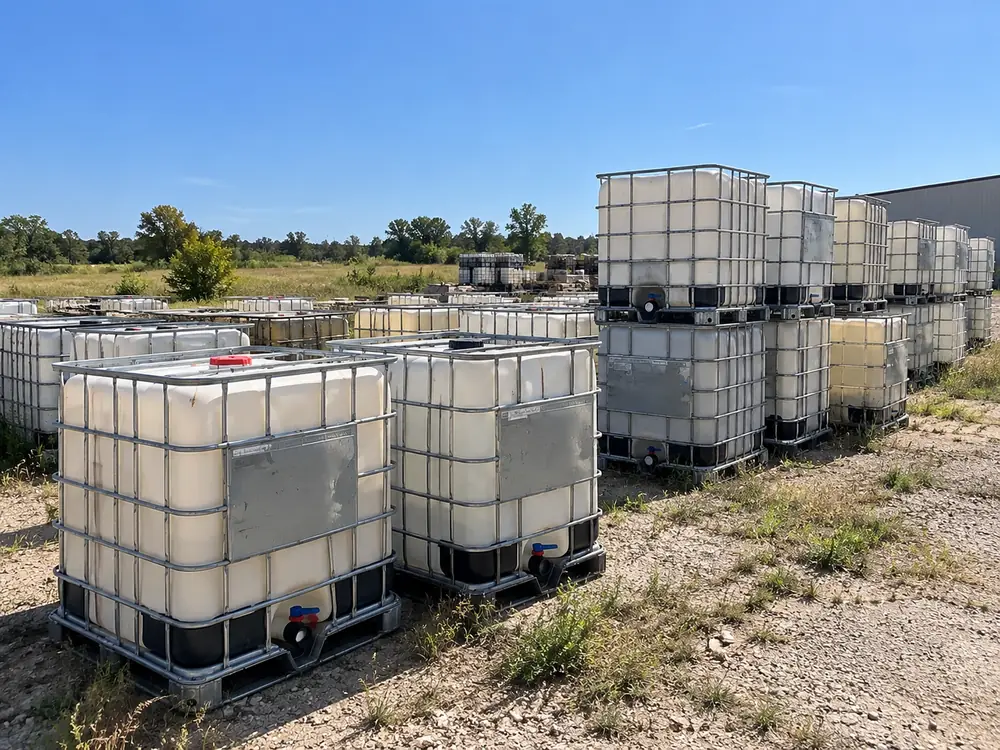
Leaving them bare in the sun. The containers in this photograph are on a three-to-five year clock rather than a ten-to-fifteen year one. A tarp, a lean-to, or siting them on the north side of a building is the highest-return thing you can do for a tote fleet.
Mixing the two populations. Inputs and water. Totes migrate — they get borrowed in a busy week and moved by somebody else — and six months later nobody can tell which held fertiliser. Stencil the cages; we will do it to your wording before dispatch at no charge.