Totes are cheap.
Moving air is expensive.
An empty IBC is a 48 by 40 inch box of nothing, nearly four feet tall. Which is why we bought our own trucks rather than discounting harder — load factor and backhaul availability move delivered cost further than unit price ever will.
Quote a lane
Origin or destination ZIP, quantity, and whether there is a dock or a forklift at the far end.
Tell us what you have.
We will tell you what it is worth.
Buying, selling, washing, hauling or recycling — one form covers all of it. Replies come from a specialist in York, PA, by email, inside one business day.
Prefer plain email? Write to info@ibctotesreco.com — include your ZIP, quantity and what the totes last held.
A 48-foot flatbed carries 40 empty totes single-stacked, a 53-foot trailer 45, and up to 80 in two tiers where the product and cage condition allow. We run our own equipment across Pennsylvania, Maryland, New Jersey, New York, Virginia and Ohio and use partner carriers for the rest of the lower 48. Delivered orders normally start at four units; yard collection has no minimum.
Choosing a mode
- Flatbed. Fastest to load and unload, works with any forklift from either side, and the default for 20 units and up. Needs the load strapped properly — a tier of empty totes is light, tall and keen to move in a crosswind.
- Dry van. Protects from weather and road grime, which matters for food-grade and rebottled stock. Requires a dock or a lift-gate and takes longer to unload.
- Straight truck with lift-gate. For four to twelve units going somewhere without a dock or forklift. More expensive per unit, and the only realistic answer for many residential and small-site deliveries.
- LTL. Possible for one to four units but handling damage risk rises with every terminal transfer. We will quote it and tell you honestly when consolidating into a later full load is the better choice.
- Yard collection. Cheapest, no minimum, appointment only.
What makes a lane cheap or expensive
Direction of trade. Our trucks go out loaded with graded stock and come back loaded with empties we bought. A lane where we already have a return leg costs you a fraction of one where we would run empty.
Access. A paved pad, a forklift and an operator can turn a 40-unit unload into forty minutes. Soft ground, no lift and a single pallet jack can turn it into half a day, and that time is in the price whether anyone writes it down or not.
Window flexibility. A fixed date on a thin lane is a premium product. A three-day window is often the single biggest saving available to you.
Stacking. Two tiers nearly doubles the units per truck, but only Grade A and B units with square cages may be used as a stacking base. This is one of several places where buying a slightly better grade is cheaper overall.
Typical transit from York, Pennsylvania
| Destination | Distance | Transit | Mode | Backhaul pricing |
|---|---|---|---|---|
| Harrisburg / Lancaster, PA | 25–45 mi | Same day | Flatbed / van | Frequent |
| Philadelphia, PA | 95 mi | Same day | Flatbed / van | Daily |
| Baltimore, MD | 60 mi | Same day | Flatbed / van | Daily |
| Washington, DC | 95 mi | Same day | Van | Frequent |
| Northern NJ / NYC | 175 mi | Next day | Van | Frequent |
| Pittsburgh, PA | 200 mi | Next day | Flatbed | Twice weekly |
| Richmond, VA | 230 mi | Next day | Flatbed | Weekly |
| Columbus, OH | 390 mi | 1–2 days | Flatbed | Common |
| Buffalo / Rochester, NY | 300 mi | 1–2 days | Flatbed | Weekly |
| Charlotte, NC | 450 mi | 2 days | Partner | Occasional |
| Chicago, IL | 650 mi | 2 days | Partner | Occasional |
| Atlanta, GA | 700 mi | 2–3 days | Partner | Rare |
| Texas triangle | 1,400 mi | 3–4 days | Partner | Rare |
| West coast | 2,700 mi | 5–6 days | Partner | No |
Five minutes of preparation saves an afternoon
Send this list to whoever will be on the dock.
Confirm the access honestly
Can a 53-foot trailer turn in, and can it back up? If the answer is 'probably', the answer is no — tell us and we will send something smaller. A truck that cannot deliver still charges for the trip.
Have a forklift and an operator ready
Not a forklift somewhere on site. One at the door, with fuel, with an operator for the window we agreed. Empty totes are light but tall, and a 40-unit unload is forty minutes with a lift and four hours without.
Clear a flat, firm landing area
Empty units will blow around on a windy pad. Have somewhere to set them down where they can be strapped or stacked immediately, and remember that once filled each one weighs about 2,400 lb.
Inspect before you sign
Count the units and look at them while the driver is still there. Transit damage must be noted on the delivery receipt at unloading; it is extremely difficult to settle afterwards.
Keep the paperwork together
Delivery receipt, grade certificate, test records and the photo set all reference the same serials. Filed together they answer almost every question anyone will ask later.
Freight FAQ
How many IBC totes fit on a truck?
Forty on a 48-foot flatbed single-stacked, forty-five on a 53-foot trailer, and up to eighty in two tiers where the product, the destination and the cage condition allow stacking. Empty totes are light and tall, so you almost always run out of deck space long before you run out of weight — which is exactly why load factor dominates the delivered price.
Why does freight sometimes cost more than the tote?
Because a 275-gallon tote is cheap and occupies a 48 by 40 inch footprint nearly four feet tall. Moving one unit 300 miles costs roughly what moving eight costs, so the per-unit freight on a single tote can genuinely exceed the container. The fix is load consolidation: order four or more, accept a backhaul window, or collect from the yard.
Do you deliver to residential addresses?
Yes, with caveats we will spell out before you order. A tractor-trailer cannot always turn or back into a residential street, and there is rarely a forklift at the other end. We will quote a lift-gate truck or a smaller straight truck, and you will need somewhere flat and firm to put a 137 lb empty container — or 2,400 lb once you fill it.
Can I collect from the yard myself?
Please do — it is the cheapest option and there is no minimum. Book an appointment so the stock is pulled, photographed and staged before you arrive. Three totes fit in a standard pickup bed with the tailgate down and proper strapping; nine fit on a 16-foot trailer.
Do you ship hazardous materials?
We ship empty containers, which is not a regulated movement. Filling a reconditioned IBC with a regulated liquid and shipping it is your obligation as the shipper, and it requires an authorised packaging, correct marking and proper documentation. Our plain-English guide to those duties is on the hazmat shipping page.
What is backhaul pricing?
When a truck is already returning on a lane it would otherwise run empty, the marginal cost of your load is small and we price it accordingly. It usually means accepting a two or three day window rather than a fixed date. On the Columbus, Pittsburgh and Richmond lanes it can cut delivered cost by a fifth or more.
Related pages
Twenty-five lanes, eight vehicle types, every load factor
Transit times on our own equipment where stated, partner carriers beyond. Backhaul availability is the column that moves your price most.
| Destination | Distance | Transit | Mode | Equipment | Backhaul pricing |
|---|---|---|---|---|---|
| Harrisburg / Lancaster, PA | 35 mi | Same day | Flatbed / van | Own | Frequent |
| York / Hanover, PA | 12 mi | Same day | Flatbed | Own | Daily |
| Philadelphia, PA | 95 mi | Same day | Flatbed / van | Own | Daily |
| Allentown / Reading, PA | 80 mi | Same day | Flatbed | Own | Frequent |
| Pittsburgh, PA | 200 mi | Next day | Flatbed | Own | Twice weekly |
| Baltimore, MD | 60 mi | Same day | Flatbed / van | Own | Daily |
| Washington, DC | 95 mi | Same day | Van | Own | Frequent |
| Northern NJ / NYC | 175 mi | Next day | Van | Own | Frequent |
| Wilmington, DE | 75 mi | Same day | Flatbed | Own | Weekly |
| Richmond, VA | 230 mi | Next day | Flatbed | Own | Weekly |
| Norfolk, VA | 300 mi | 1–2 days | Flatbed | Own | Occasional |
| Buffalo / Rochester, NY | 300 mi | 1–2 days | Flatbed | Own | Weekly |
| Columbus, OH | 390 mi | 1–2 days | Flatbed | Own | Common |
| Cleveland, OH | 350 mi | 1–2 days | Flatbed | Own | Occasional |
| Charlotte, NC | 450 mi | 2 days | Flatbed | Partner | Occasional |
| Atlanta, GA | 700 mi | 2–3 days | Flatbed | Partner | Rare |
| Chicago, IL | 650 mi | 2 days | Flatbed | Partner | Occasional |
| Detroit, MI | 450 mi | 2 days | Flatbed | Partner | Occasional |
| Boston / New England | 400 mi | 2 days | Van | Partner | Occasional |
| Nashville, TN | 700 mi | 2–3 days | Flatbed | Partner | Rare |
| Dallas / Houston, TX | 1,450 mi | 3–4 days | Flatbed | Partner | Rare |
| Denver, CO | 1,700 mi | 4 days | Flatbed | Partner | No |
| Phoenix, AZ | 2,200 mi | 5 days | Flatbed | Partner | No |
| California | 2,700 mi | 5–6 days | Flatbed | Partner | No |
| Pacific Northwest | 2,700 mi | 5–6 days | Flatbed | Partner | No |
| Vehicle | Single tier | Two tier | Weight, single tier | Note |
|---|---|---|---|---|
| 48 ft flatbed | 40 | 80 | 5,480 lb | Default for 20 units and up |
| 53 ft trailer | 45 | 90 | 6,165 lb | Needs a dock or lift gate |
| 26 ft straight truck | 12 | 24 | 1,644 lb | Lift gate rating governs |
| 16 ft box trailer | 9 | 18 | 1,233 lb | Ground-level loading |
| 20 ft shipping container | 16 | 32 | 2,192 lb | Door height suits 46" formats |
| 40 ft shipping container | 36 | 72 | 4,932 lb | Floor-loaded, blocked and braced |
| Pickup bed, tailgate down | 3 | — | 411 lb | Strap to the bed, not the cage top |
| Transit / cargo van | 2 | — | 274 lb | Check interior height |
Five minutes of preparation saves an afternoon
Send this to whoever will be on the dock. The worst outcome in freight is a truck that arrives and cannot deliver.
- Confirm the access honestly. Can a 53-foot trailer turn in *and* back up? If the answer is “probably”, it is no — tell us and we send something smaller.
- Have a forklift and an operator at the door, fuelled, in the agreed window. Not somewhere on site.
- Check the forklift rating at your real load centre. A truck plated 5,000 lb at 24 inches may be rated far lower for a 48-inch-deep tote.
- Clear a flat, firm landing area. Empty totes present four feet of sail and will redistribute themselves in a crosswind.
- Confirm clear height if the load is two-tier — two tiers plus deck exceeds many door heights.
- Inspect and count before you sign. Transit damage must be noted on the delivery receipt at unloading.
- File the paperwork together. Delivery receipt, grade certificate, test records and the photo set all reference the same serials.
Filled weights — what the load becomes once you fill it
| Product | SG | 275 gal filled | 330 gal filled | 550 gal filled |
|---|---|---|---|---|
| Acetone | 0.79 | 1,883 lb | 2,273 lb | 3,756 lb |
| Ethanol | 0.79 | 1,883 lb | 2,273 lb | 3,756 lb |
| Kerosene | 0.81 | 1,927 lb | 2,327 lb | 3,845 lb |
| Citrus terpene oil | 0.84 | 1,993 lb | 2,407 lb | 3,978 lb |
| Diesel fuel | 0.85 | 2,016 lb | 2,433 lb | 4,022 lb |
| Mineral oil, hydraulic | 0.88 | 2,082 lb | 2,514 lb | 4,155 lb |
| Biodiesel B100 | 0.88 | 2,082 lb | 2,514 lb | 4,155 lb |
| Concrete release agent | 0.89 | 2,104 lb | 2,540 lb | 4,200 lb |
| Gear oil | 0.90 | 2,126 lb | 2,567 lb | 4,244 lb |
| Canola oil | 0.91 | 2,148 lb | 2,594 lb | 4,289 lb |
| Soybean / olive oil | 0.92 | 2,170 lb | 2,620 lb | 4,333 lb |
| Flavour concentrate | 0.95 | 2,237 lb | 2,700 lb | 4,466 lb |
| Amine corrosion inhibitor | 0.98 | 2,303 lb | 2,780 lb | 4,599 lb |
| Water | 1.00 | 2,347 lb | 2,834 lb | 4,688 lb |
| Antifoam emulsion | 1.00 | 2,347 lb | 2,834 lb | 4,688 lb |
| Quaternary sanitiser | 1.01 | 2,369 lb | 2,860 lb | 4,732 lb |
| Asphalt emulsion | 1.01 | 2,369 lb | 2,860 lb | 4,732 lb |
| Maple sap | 1.02 | 2,391 lb | 2,887 lb | 4,777 lb |
| Non-ionic surfactant | 1.03 | 2,413 lb | 2,914 lb | 4,821 lb |
| Milk / dairy intermediate | 1.03 | 2,413 lb | 2,914 lb | 4,821 lb |
| Car wash soap concentrate | 1.04 | 2,436 lb | 2,941 lb | 4,865 lb |
| Propylene glycol | 1.04 | 2,436 lb | 2,941 lb | 4,865 lb |
| Anionic surfactant | 1.05 | 2,458 lb | 2,967 lb | 4,910 lb |
| Apple cider | 1.05 | 2,458 lb | 2,967 lb | 4,910 lb |
| Spent grain slurry | 1.05 | 2,458 lb | 2,967 lb | 4,910 lb |
| Laundry detergent | 1.06 | 2,480 lb | 2,994 lb | 4,954 lb |
| Flexographic ink | 1.08 | 2,524 lb | 3,047 lb | 5,043 lb |
| Wine / must | 1.08 | 2,524 lb | 3,047 lb | 5,043 lb |
| Acrylic adhesive emulsion | 1.08 | 2,524 lb | 3,047 lb | 5,043 lb |
| Urea solution (DEF) | 1.09 | 2,546 lb | 3,074 lb | 5,087 lb |
| Alkaline degreaser | 1.10 | 2,568 lb | 3,101 lb | 5,132 lb |
| Humic acid | 1.10 | 2,568 lb | 3,101 lb | 5,132 lb |
| Tomato paste | 1.10 | 2,568 lb | 3,101 lb | 5,132 lb |
| Ethylene glycol | 1.11 | 2,590 lb | 3,127 lb | 5,176 lb |
| Peracetic acid sanitiser | 1.12 | 2,612 lb | 3,154 lb | 5,220 lb |
| Fruit purée | 1.12 | 2,612 lb | 3,154 lb | 5,220 lb |
| Hydrogen peroxide 35% | 1.13 | 2,634 lb | 3,181 lb | 5,265 lb |
| Acid descaler | 1.14 | 2,657 lb | 3,207 lb | 5,309 lb |
| Hydrochloric acid 31% | 1.16 | 2,701 lb | 3,261 lb | 5,398 lb |
| Glyphosate concentrate | 1.17 | 2,723 lb | 3,287 lb | 5,442 lb |
| Brine 23% / soy sauce | 1.20 | 2,789 lb | 3,368 lb | 5,575 lb |
| Sodium hypochlorite 12% | 1.21 | 2,811 lb | 3,394 lb | 5,620 lb |
| Phosphate coating | 1.22 | 2,833 lb | 3,421 lb | 5,664 lb |
| Pigment dispersion | 1.25 | 2,900 lb | 3,501 lb | 5,797 lb |
| Nickel plating solution | 1.25 | 2,900 lb | 3,501 lb | 5,797 lb |
| Foliar micronutrient | 1.25 | 2,900 lb | 3,501 lb | 5,797 lb |
| Glycerine | 1.26 | 2,922 lb | 3,528 lb | 5,841 lb |
| Sulphuric acid 35% | 1.26 | 2,922 lb | 3,528 lb | 5,841 lb |
| Sodium hydroxide 25% | 1.27 | 2,944 lb | 3,554 lb | 5,886 lb |
| UAN 28 | 1.28 | 2,966 lb | 3,581 lb | 5,930 lb |
| Potassium acetate de-icer | 1.28 | 2,966 lb | 3,581 lb | 5,930 lb |
| Latex paint | 1.30 | 3,010 lb | 3,634 lb | 6,019 lb |
| UAN 32 fertiliser | 1.32 | 3,054 lb | 3,688 lb | 6,108 lb |
| Magnesium chloride de-icer | 1.32 | 3,054 lb | 3,688 lb | 6,108 lb |
| Liquid sugar / maple syrup | 1.33 | 3,076 lb | 3,715 lb | 6,152 lb |
| Ammonium thiosulphate | 1.33 | 3,076 lb | 3,715 lb | 6,152 lb |
| Aluminium sulphate | 1.33 | 3,076 lb | 3,715 lb | 6,152 lb |
| Juice concentrate (70 Bx) | 1.35 | 3,121 lb | 3,768 lb | 6,241 lb |
| Polyaluminium chloride | 1.35 | 3,121 lb | 3,768 lb | 6,241 lb |
| Liquid starter 10-34-0 | 1.38 | 3,187 lb | 3,848 lb | 6,374 lb |
| High-fructose corn syrup | 1.38 | 3,187 lb | 3,848 lb | 6,374 lb |
| Calcium chloride brine | 1.38 | 3,187 lb | 3,848 lb | 6,374 lb |
| Sodium silicate | 1.39 | 3,209 lb | 3,875 lb | 6,418 lb |
| Molasses / honey | 1.42 | 3,275 lb | 3,955 lb | 6,551 lb |
| Ferric chloride 40% | 1.42 | 3,275 lb | 3,955 lb | 6,551 lb |
| Calcium nitrate solution | 1.43 | 3,297 lb | 3,981 lb | 6,596 lb |
| Potassium hydroxide 45% | 1.46 | 3,364 lb | 4,061 lb | 6,729 lb |
| Potassium thiosulphate | 1.47 | 3,386 lb | 4,088 lb | 6,773 lb |
| Sodium hydroxide 50% | 1.52 | 3,496 lb | 4,222 lb | 6,995 lb |
| Phosphoric acid 75% | 1.58 | 3,629 lb | 4,382 lb | 7,261 lb |
| Sulphuric acid 93% | 1.83 | 4,181 lb | 5,049 lb | 8,370 lb |
| Configuration | Load per beam level | Rating needed |
|---|---|---|
| One 275 gal, water | 2,347 lb | 3,000 lb level |
| One 275 gal, SG 1.3 | 2,010 lb liquid + tare = 2,872 lb | 3,000 lb level, tight |
| Two 275 gal, water | 4,694 lb | 5,000 lb level |
| Two 275 gal, SG 1.3 | 5,744 lb | 6,000 lb level |
| Two 275 gal, SG 1.5 | 6,620 lb | 7,000 lb level |
| One 330 gal, water | 2,834 lb | 3,000 lb level, tight |
| Two 330 gal, water | 5,668 lb | 6,000 lb level |
| Two 330 gal, SG 1.3 | 6,936 lb | 7,000 lb level, tight |
| One 550 gal, water | 4,688 lb | 5,000 lb level |
| One 275 gal stainless, water | 2,436 lb | 3,000 lb level |
Formats and footprints — what fits where
| Format | Nominal | Usable | L × W × H | Tare (steel base) | Gross, water | Outlet | Stack filled | Availability |
|---|---|---|---|---|---|---|---|---|
| 275 gal standard | 275 gal / 1,041 L | 265 gal | 48 × 40 × 46" | 137 lb | 2,347 lb | 2" S60x6 | 2 high | Ex-stock |
| 275 gal tall | 275 gal / 1,041 L | 264 gal | 48 × 40 × 53" | 141 lb | 2,342 lb | 2" S60x6 | 2 high | Regular |
| 330 gal standard | 330 gal / 1,249 L | 320 gal | 48 × 40 × 53" | 165 lb | 2,834 lb | 2" S60x6 | 2 high | Ex-stock |
| 350 gal | 350 gal / 1,325 L | 338 gal | 48 × 40 × 58" | 172 lb | 2,991 lb | 2" or 3" | 2 high | Occasional |
| 400 gal | 400 gal / 1,514 L | 386 gal | 48 × 46 × 60" | 198 lb | 3,417 lb | 3" buttress | 1 high | Order |
| 550 gal | 550 gal / 2,082 L | 532 gal | 48 × 48 × 72" | 251 lb | 4,688 lb | 3" buttress | 1 high | Occasional |
| 120 gal mini | 120 gal / 454 L | 115 gal | 32 × 32 × 36" | 71 lb | 1,030 lb | 2" S60x6 | 2 high | Occasional |
| 180 gal | 180 gal / 681 L | 174 gal | 40 × 40 × 42" | 98 lb | 1,549 lb | 2" S60x6 | 2 high | Order |
| Stainless 265 gal | 265 gal / 1,003 L | 258 gal | 48 × 40 × 50" | 285 lb | 2,436 lb | 2" tri-clamp | 2 high | Occasional |
| Stainless 330 gal | 330 gal / 1,249 L | 322 gal | 48 × 40 × 56" | 330 lb | 3,015 lb | 2" tri-clamp | 2 high | Occasional |
| Stainless 400 gal | 400 gal / 1,514 L | 390 gal | 48 × 46 × 62" | 385 lb | 3,637 lb | 3" tri-clamp | 1 high | Order |
| Stainless 500 gal | 500 gal / 1,893 L | 488 gal | 48 × 48 × 68" | 430 lb | 4,600 lb | 3" tri-clamp | 1 high | Order |
Seasonality — when lanes are tight
| Month | Food-grade demand | Industrial demand | Inbound supply | What it means for you |
|---|---|---|---|---|
| January | Low | High (de-icer) | Average | Winter emergencies; frozen heels slow the gate |
| February | High (maple starts) | High | Average | Sugaring floats go out; access often difficult |
| March | Highest (maple peak) | Moderate | Low | Freeze-damage crop arrives from last autumn |
| April | High | High (fertiliser) | Average | Maple returns, spring inputs ship |
| May | Average | Highest (fertiliser) | High | Biggest Grade B volume window |
| June | Average | High | High | Best month to sell us empties |
| July | Low | Average | Highest | Deepest stock; cheapest buying |
| August | Low | Average | Highest | Book autumn food-grade now |
| September | Highest (cider, crush) | High (de-icer fill) | Low | The squeeze begins |
| October | Highest | High | Lowest | Food-grade lead times stretch to 2–3 weeks |
| November | Average | Highest | Low | Winter chemistry fills; order covers and jackets |
| December | Average (juice runs) | High | Low | Holiday-week bookings close early |
Documents that travel with a load
| Document | What it contains | When you get it |
|---|---|---|
| Written quotation | Unit price by grade, freight as its own line, validity, and the conditions that would change it | Before you order |
| Grade certificate | Assigned grade against our published definitions, per unit serial | With the order |
| Leak & pressure test record | Test pressure, hold time, outcome, per serial | With the order |
| Hydrostatic test certificate | 100% of food-line units, recorded against serial | Food-grade orders |
| Prior-contents declaration | Named last product, generating site, signature | Anything we collected |
| Wash programme record | Bay, programme, temperature, chemistry, cycle time | Reconditioned & contract work |
| Rinse verification | Final-rinse pH and conductivity | Reconditioned & contract work |
| Component specification | Valve, gasket, lid materials with compliance references | Food-grade orders |
| Photograph set | The actual units on the rack before loading | Every order |
| Weight ticket | Certified-scale gross weight and count | Collections and cleanouts |
| Diversion certificate | Unit counts, weights by stream, destination routes, dates | End-of-life batches |
| Certificate of insurance | GL, auto, cargo, workers' comp; additional insured | Before a crew arrives |
| Reconditioner marking detail | Code, date, design type | Re-marked units |
| Lease schedule | Count, grade, dates, weekly rate, return condition, replacement charge | Leases |
Standards relevant to shipping regulated liquids
| Reference | Title | What it covers | Who it binds |
|---|---|---|---|
| 49 CFR 172.101 | Hazardous materials table | Classification and authorised packaging reference | Shippers |
| 49 CFR 172 Subpart H | Training | Who must be trained, in what, how often, with records | Any hazmat employer |
| 49 CFR 173 | Shippers — general requirements by class | Whether an IBC is authorised for your entry | Shippers |
| 49 CFR 178 Subpart N | IBC design types, testing and marking | What the plate means and how it was earned | Makers, reconditioners |
| 49 CFR 180.352 | Periodic inspection, testing, repair & remanufacture | 2.5-year visual, 5-year leakproofness + full inspection | Owners, shippers |
| 40 CFR 261.7 | RCRA empty containers | When a container counts as empty; P-list triple rinse | Generators |
| 40 CFR 262 | Generator standards | Waste determination, manifesting, accumulation | Generators |
| 21 CFR 177.1520 | Olefin polymers | HDPE compliance for food contact | Food users |
| 21 CFR 177.2600 | Rubber articles for repeated use | Gasket and seal compliance for food contact | Food users |
| 21 CFR 110 / 117 | Good manufacturing practice | Handling, storage, sanitation programmes | Food users |
| NSF/ANSI 61 | Drinking water system components | Potable-contact material evaluation | Water utilities |
| 29 CFR 1910.1200 | Hazard communication | Workplace labelling and safety data sheets | Everyone |
| 29 CFR 1910.146 | Permit-required confined spaces | Entry into tanks and vessels | Anyone cleaning containers |
| 29 CFR 1910.178 | Powered industrial trucks | Forklift operation and certification | Yards and docks |
| ANSI/ITSDF B56.1 | Low-lift and high-lift trucks | Capacity ratings and load centres | Yards and docks |
| ANSI MH16.1 | Steel storage racking | Beam capacity, deflection, inspection | Warehouses |
| PA Title 25 Ch. 95 | Wastewater treatment requirements | Industrial discharge standards in Pennsylvania | Wash lines |
| ISPM-15 | Wood packaging in international trade | Heat treatment and marking of timber pallets | Exporters |
Six freight mistakes and what each one costs
Optimistic access answers
A truck that arrives and cannot deliver still charges for the trip, and the lane has to run twice.
No forklift assigned
A 40-unit unload is forty minutes with a lift and an operator, and four hours without. That time is in the price either way.
Ordering one unit delivered
A truck costs what it costs down a lane. Per-unit freight on a single container is roughly forty times the full-load figure.
Insisting on a fixed date on a thin lane
A two or three day window is often the single biggest saving available to you.
Buying the cheapest grade for a long lane
Only square-caged Grade A and B units can form a filled or stacked lower tier. The better grade can be cheaper delivered.
Residential drops with nobody present
A kerbside drop of four tall containers needs somebody there and somewhere flat to put them immediately.
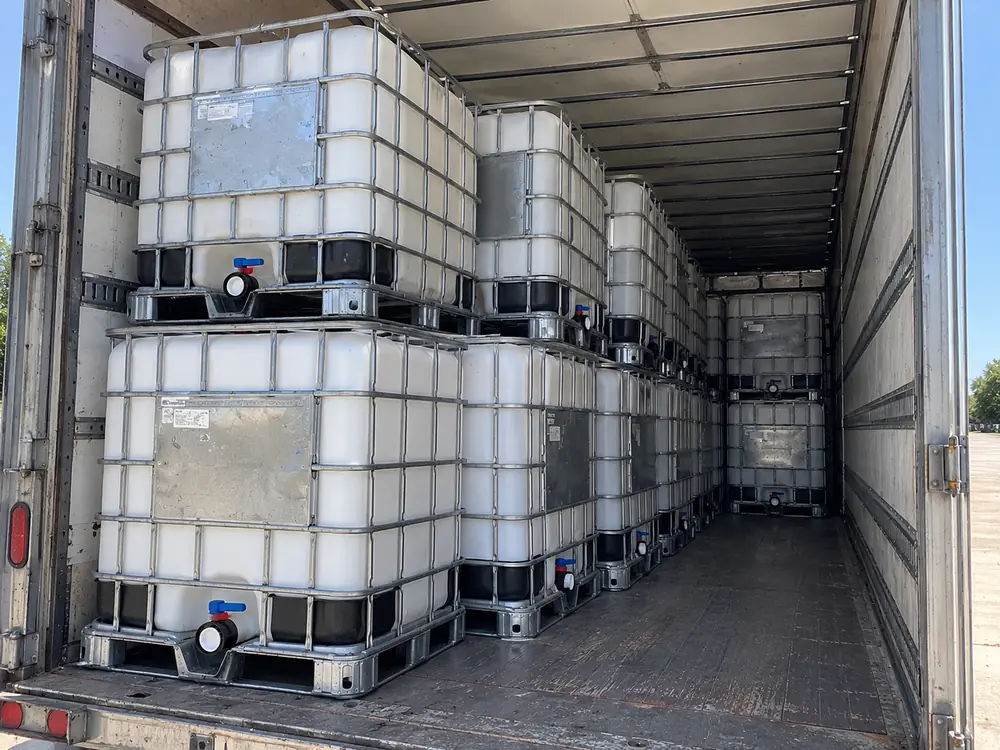
Why this load is secured the way it is
Conventional flatbed securement is sized against a load trying to continue in a straight line when the truck does not. An empty tote inverts that: sixteen square feet of flat side at 137 lb means the force trying to move it comes mostly from air, arrives laterally and unpredictably, and is largest on the outside units of the upper tier.
- Straps go over the cage top rails, never around the bottle.
- Edge protectors at every rail — a tensioned strap abrades its own webbing within a few hundred miles.
- Tiers interlocked where the cage top is shaped to accept a pallet above.
- Tension checked after the first twenty miles; empty loads settle and nest.
- Front and rear blocking, because friction scales with mass and this load has very little.