Second lives for
Grade C containers
A bottle too stained to hold product is still a sound, watertight, forklift-ready 275-gallon vessel. We have a fabrication corner whose entire job is finding it something useful to do instead of granulating it.
Commission a build
Describe what you want to hold, grow, wash or store. We quote builds, kits and parts-only.
Tell us what you have.
We will tell you what it is worth.
Buying, selling, washing, hauling or recycling — one form covers all of it. Replies come from a specialist in York, PA, by email, inside one business day.
Prefer plain email? Write to info@ibctotesreco.com — include your ZIP, quantity and what the totes last held.
Grade C totes are watertight and structurally sound but cosmetically marked, which makes them the cheapest large vessel available anywhere. We build nine standard products from them — rain harvesting, aquaponics, wash stations, fire-suppression storage, wicking beds, planters, livestock troughs, dog baths and bar tops — and we will quote one-off fabrications. Food-adjacent builds use documented edible-prior stock only.
Rainwater harvesting kit
275 gallons on a stand, with a bulkhead spigot, a leaf-and-debris pre-filter, an overflow to a second tote, a vented lid and a UV cover. Expandable to a four-tote 1,100-gallon array that fills from one downspout.
Full build guideAquaponics & hydro beds
A tote cut on the horizontal gives you a deep sump below and a wide grow bed above from one container. Supplied with bulkheads, a siphon standpipe and the cage retained as a trellis frame.
Wash & rinse stations
Gravity-fed hand or tool wash with a 2-inch butterfly outlet, hose tail, drain tray and optional 120 V heater jacket for winter use. Popular with orchards, kennels and mechanical shops.
Fire-suppression storage
Static water storage for rural properties and remote sites, plumbed for a 2.5-inch adapter so a pumper can draft from it. Multi-tote arrays manifolded together on a common header.
Wicking beds & planters
Half-tote raised beds with an internal reservoir and a wicking medium, so a bed waters itself for a fortnight. Cage trimmed and retained as the bed's frame.
Livestock troughs & dog baths
Cut, edge-capped and drilled for a drain. The cage makes a natural splash and trample guard. Edible-prior stock only, for obvious reasons.
Compost and worm bins
Ventilated, drained and lidded, on a stand at working height. The single most popular build with community gardens in the York and Lancaster area.
Bar tops & furniture
Cage frames and pallet decks become industrial-looking counters, benches and standing desks. Taprooms love them; we built eleven last year.
Something else entirely
Describe what you need to hold, grow or wash. We quote one-off fabrication out of the same Grade C stock.
OpenFive rules for working with a used tote
Learned by doing it wrong at least once each.
Know what it held, properly
Not 'industrial chemicals' — the name of the product. A tote that held liquid fertiliser is fine as a fire-water tank and entirely unsuitable as a vegetable wicking bed, and no amount of washing changes that.
Never freeze it full and sealed
Water expands roughly 9% on freezing. A full, sealed tote in a hard freeze will bulge, split a wall panel or blow the valve boss. Drain it, or leave it two-thirds full with a vented lid.
Shade it, or at least cover it
UV is what kills a poly bottle, not water and not age. A covered tote comfortably doubles or triples its outdoor life, and in a clear bottle a cover also stops algae growing in stored water.
Support the base properly
A full 275-gallon tote is about 2,400 lb. On soft ground it will sink unevenly and rack the cage. Put it on a level pad, gravel bed or dedicated stand — the pallet is for forklifts, not for foundations.
Cut with the cage, not against it
If you are cutting a bottle, plan the cut so the cage still braces what is left. Removing a horizontal cage member near a cut line is how a half-tote bed ends up bowing outwards by August.
What fits in a tote
| Build | Usable volume | Footprint | Filled weight |
|---|---|---|---|
| Full tote, rain harvest | 265 gal usable | 48 × 40" | ≈ 2,350 lb |
| Full tote, fire water | 270 gal usable | 48 × 40" | ≈ 2,390 lb |
| Half tote, wicking bed | 11 cu ft media + 40 gal | 48 × 40" | ≈ 950 lb |
| Half tote, trough | 120 gal | 48 × 40" | ≈ 1,060 lb |
| Two-tote array | 530 gal | 96 × 40" | ≈ 4,700 lb |
| Four-tote array | 1,060 gal | 96 × 80" | ≈ 9,400 lb |
| Cage only, racking | — | 48 × 40 × 46" | ≈ 62 lb |
Every upcycled build is a container that was one decision away from the granulator. Last year the fabrication corner diverted 1,840 units that had already failed reuse twice.
It is the least profitable line in the business and the one we are least likely to drop. If you would rather build it yourself, we will sell you the parts and the method — the rainwater harvesting guide is a complete build with a parts list.
Open the build guideUpcycling FAQ
Are upcycled totes safe for a vegetable garden?
If the prior service was edible, yes — and we only build food-adjacent products (aquaponics, garden irrigation, wicking beds) from documented edible-prior stock. For an ornamental planter or a non-edible application we will use Grade C industrial stock and tell you exactly what it held, so you can make your own call. We will not quietly build a vegetable bed out of a fertiliser tote.
Will a tote survive a Pennsylvania winter outdoors?
Yes, with two precautions. Never leave it full and sealed through a hard freeze — water expands and will bulge or split the bottle, so either drain it or leave at most two thirds full with the lid vented. And shade or cover it: UV is what actually kills a poly bottle, and a covered tote lasts two or three times as long as a bare one in full sun.
Can you ship an upcycled build?
Rain-harvest kits, planters and wash stations ship on our own flatbeds within our lanes and by partner carrier beyond. The larger multi-tote installations — aquaponics runs, fire-suppression arrays — we prefer to deliver and set ourselves, because getting the levels and the plumbing right on site is most of the value.
Can I buy just the parts and build it myself?
Absolutely, and we would rather you did if you enjoy that sort of thing. We sell Grade C totes, bulkhead fittings, spigots, overflow kits, filters, cage sections and pallets, and the rainwater harvesting guide walks through a full build with a parts list.
Why do you do this if it is barely profitable?
Because the alternative for a sound Grade C container with a stained wall is the granulator, and granulating a container that could hold rainwater for fifteen years is the exact thing this company exists to prevent. It also keeps the fabrication skills in the building, which is useful when a customer needs something odd.
Related pages
Capacities, loads and what each build actually takes
A Grade C tote is a watertight, forklift-ready 265-gallon vessel in a rated steel frame. The numbers below are what that means in practice.
| Build | Usable volume | Footprint | Filled weight | Prior service needed |
|---|---|---|---|---|
| Full tote, rain harvest | 265 gal | 48 × 40" | ≈ 2,350 lb | Edible-prior if irrigating food |
| Full tote, fire water | 270 gal | 48 × 40" | ≈ 2,390 lb | Any declared |
| Full tote, livestock water | 265 gal | 48 × 40" | ≈ 2,350 lb | Edible-prior only |
| Half tote, wicking bed | 11 cu ft media + 40 gal | 48 × 40" | ≈ 950 lb | Edible-prior only |
| Half tote, trough | 120 gal | 48 × 40" | ≈ 1,060 lb | Edible-prior only |
| Half tote, planter | 14 cu ft media | 48 × 40" | ≈ 900 lb | Any declared (ornamental) |
| Full tote, wash station | 265 gal | 48 × 40" | ≈ 2,350 lb | Any declared |
| Full tote, compost bin | 35 cu ft | 48 × 40" | ≈ 1,400 lb | Any declared |
| Two-tote array | 530 gal | 96 × 40" | ≈ 4,700 lb | Per application |
| Four-tote array | 1,060 gal | 96 × 80" | ≈ 9,400 lb | Per application |
| Cage only, racking or furniture | — | 48 × 40 × 46" | ≈ 62 lb | Irrelevant |
| Roof area | 0.5" rain | 1" rain | 2" rain | Annual, 42in |
|---|---|---|---|---|
| 200 sq ft | 60 gal | 120 gal | 240 gal | ≈ 5,000 gal |
| 400 sq ft | 120 gal | 240 gal | 480 gal | ≈ 10,000 gal |
| 600 sq ft | 180 gal | 360 gal | 720 gal | ≈ 15,000 gal |
| 1,000 sq ft | 300 gal | 600 gal | 1,200 gal | ≈ 25,000 gal |
| 1,500 sq ft | 450 gal | 900 gal | 1,800 gal | ≈ 38,000 gal |
| 2,000 sq ft | 600 gal | 1,200 gal | 2,400 gal | ≈ 50,000 gal |
Which prior service suits which build
The rule that governs everything here: if the water or medium touches anything edible, the container must have documented edible prior service.
| Prior product | Family | Food-grade eligible? | Programme | Best grade | Seal | Note |
|---|---|---|---|---|---|---|
| Apple juice concentrate (70 Bx) | Food & beverage | Yes | PF | A | FDA EPDM | Best inbound stock we see; sugars rinse clean |
| Orange juice concentrate | Food & beverage | Yes | PF | A | FDA Viton | Citrus oil fraction can scent the bottle |
| Grape juice concentrate | Food & beverage | Yes | PF | A | FDA EPDM | Watch for tartrate scale at the outlet |
| Liquid sugar / sucrose syrup | Food & beverage | Yes | PF | A | FDA EPDM | Hot rinse only, no caustic needed |
| High-fructose corn syrup | Food & beverage | Yes | PF | A | FDA EPDM | Viscous; 3" outlet helps decanting |
| Molasses | Food & beverage | Yes | PF | A | FDA EPDM | Heated rinse; heavy heel |
| Honey | Food & beverage | Yes | PF | A | FDA EPDM | Crystallises; heater jacket recommended |
| Maple sap | Food & beverage | Yes | PF | A | FDA EPDM | Benign but sugars feed biofilm fast |
| Maple syrup | Food & beverage | Yes | PF | A | FDA EPDM | Hot rinse; inspect lid seat |
| Apple cider | Food & beverage | Yes | PF | A | FDA EPDM | Vented lid essential — ferments |
| Wine / must | Food & beverage | Yes | PF | A | FDA EPDM | Tartrate scale; usually leased |
| Beer / wort | Food & beverage | Yes | PF | A | FDA EPDM | Stainless preferred for repeat service |
| Brine (pickling liquor) | Food & beverage | Yes | PF | A | FDA Viton | Check cage for chloride attack |
| Vinegar, 10% | Food & beverage | Yes | PF | A | FDA EPDM | Easy; acid-resistant seal needed |
| Soy sauce | Food & beverage | Yes | PF | A | FDA Viton | Salt plus colour; monitor ghosting |
| Edible soybean oil | Food & beverage | Yes | P2 | A | FDA Viton | 140°F minimum or fat re-deposits |
| Edible canola oil | Food & beverage | Yes | P2 | A | FDA Viton | As above |
| Olive oil | Food & beverage | Yes | P2 | A | FDA Viton | Polyphenols can tint the wall |
| Glycerine, USP | Food & beverage | Yes | PF | A | FDA EPDM | Often effectively first-use stock |
| Propylene glycol, food grade | Food & beverage | Yes | PF | A | FDA EPDM | Frequently single-product filler stock |
| Liquid egg | Food & beverage | Case by case | PF | A | FDA EPDM | Protein film needs verification |
| Milk / dairy intermediate | Food & beverage | Case by case | PF | A | FDA EPDM | Allergen changeover record required |
| Whey concentrate | Food & beverage | Case by case | PF | A | FDA EPDM | Protein scale; hot detergent |
| Tomato paste | Food & beverage | Yes | PF | A | FDA Viton | Acidic; stains but rinses |
| Fruit purée | Food & beverage | Yes | PF | A | FDA EPDM | Pulp load; coarse settling matters |
| Flavour concentrate / essence | Food & beverage | No | Refused | Rebottle | PTFE | Permeates HDPE permanently — use stainless |
| Citrus terpene oil | Food & beverage | Never | Refused | Recycle | PTFE | One batch ends a poly bottle's usefulness |
| Spent grain slurry | Food & beverage | No | P2 | B | EPDM | By-product duty; 3" outlet strongly advised |
| Yeast slurry | Food & beverage | Case by case | P2 | B | EPDM | Vent — active fermentation |
| UAN 32 liquid nitrogen | Agricultural | Never | P1 | B | EPDM | Rinses readily; dense — check ratings |
| UAN 28 | Agricultural | Never | P1 | B | EPDM | As above |
| Liquid starter 10-34-0 | Agricultural | Never | P1 | B | EPDM | Polyphosphate scale at the outlet |
| Ammonium thiosulphate | Agricultural | Never | P1 | B | EPDM | Sulphur odour persists faintly |
| Potassium thiosulphate | Agricultural | Never | P1 | B | EPDM | Very dense; 275 format only |
| Calcium nitrate solution | Agricultural | Never | P1 | B | EPDM | Crystallises when cold |
| Humic / fulvic acid | Agricultural | Never | P2 | B | EPDM | Dark staining, usually washes out |
| Fish hydrolysate fertiliser | Agricultural | Never | P3 | C | Viton | Odour frequently permanent |
| Foliar micronutrient blend | Agricultural | Never | P1 | B | EPDM | Metal salts can tint the wall |
| Glyphosate concentrate | Agricultural | Never | P3 | C | Viton | Labelled rinse programme governs |
| 2,4-D amine concentrate | Agricultural | Never | Refused | Per label | Viton | Label prescribes rinse-and-destroy |
| Crop oil adjuvant | Agricultural | Never | P3 | C | Viton | Attacks EPDM; permeates slowly |
| Surfactant adjuvant (NIS) | Agricultural | Never | P1 | B | EPDM | Foams heavily on transfer |
| Molluscicide suspension | Agricultural | Never | Refused | Per label | Viton | Refused — labelled destruction |
| Livestock drinking water | Water & inert | Yes | P1 | A | EPDM | Effectively first-use |
| Irrigation water | Water & inert | Yes | P1 | A | EPDM | May carry silt; coarse settling |
| Sodium hydroxide 50% | Industrial chemistry | Never | P1 | B | EPDM | 3,497 lb filled — check every rating |
| Sodium hydroxide 25% | Industrial chemistry | Never | P1 | B | EPDM | Easy wash; dilute and drain |
| Potassium hydroxide 45% | Industrial chemistry | Never | P1 | B | EPDM | As NaOH; dense |
| Sulphuric acid 93% | Industrial chemistry | Never | Refused | Dedicated | PTFE | 4,182 lb filled; dedicated service only |
| Sulphuric acid 35% | Industrial chemistry | Never | P1 | C | PTFE | Fume attack on cage galvanising |
| Hydrochloric acid 31% | Industrial chemistry | Never | P1 | C | PTFE | Cage usually the limiting factor |
| Phosphoric acid 75% | Industrial chemistry | Never | P1 | B | PTFE | Dense; viscous at low temperature |
| Nitric acid 42% | Industrial chemistry | Never | Refused | Dedicated | PTFE | Oxidiser — embrittles HDPE |
| Hydrogen peroxide 35% | Industrial chemistry | Case by case | P1 | B | PTFE | Vent; absolutely no contaminants |
| Sodium hypochlorite 12% | Industrial chemistry | Never | P1 | B | EPDM | Degasses; vent and shield from UV |
| Ferric chloride 40% | Industrial chemistry | Never | P2 | C | Viton | Heavy orange staining is permanent |
| Aluminium sulphate | Industrial chemistry | Never | P1 | B | EPDM | Scale at the outlet boss |
| Polyaluminium chloride | Industrial chemistry | Never | P1 | B | EPDM | Gels if allowed to dry out |
| Propylene glycol coolant | Industrial chemistry | Never | P1 | B | EPDM | Ideal duty; nothing to watch |
| Ethylene glycol | Industrial chemistry | Never | P1 | B | EPDM | Toxic — never re-grade for potable |
| Calcium chloride brine 32% | Industrial chemistry | Never | P1 | B | Viton | Chloride attack on lower cage |
| Magnesium chloride de-icer | Industrial chemistry | Never | P1 | B | Viton | As above; rinse frames each spring |
| Potassium acetate de-icer | Industrial chemistry | Never | P1 | B | EPDM | Benign; airport runway chemistry |
| Urea solution (DEF) | Industrial chemistry | Never | P1 | B | EPDM | Purity-critical next fill; usually dedicated |
| Nickel plating solution | Industrial chemistry | Never | Refused | Recycle | Viton | Metal-bearing; never re-used |
| Chromic acid solution | Refused | Never | Refused | Refused | PTFE | Not accepted at the gate |
| Cyanide plating bath | Refused | Never | Refused | Refused | PTFE | Acutely hazardous — licensed facility only |
| Phosphate conversion coating | Industrial chemistry | Never | P2 | C | Viton | Scale and staining |
| Amine corrosion inhibitor | Industrial chemistry | Never | P2 | B | Viton | Fish-like odour can persist |
| Sodium silicate | Industrial chemistry | Never | P3 | C | EPDM | Sets hard if dried; wash promptly |
| Polymer flocculant emulsion | Industrial chemistry | Never | P3 | C | EPDM | Extremely slippery; gels with water |
| Sodium bisulphite | Industrial chemistry | Never | P1 | B | EPDM | Sulphur odour; vent |
| Antifoam silicone emulsion | Industrial chemistry | Never | P3 | C | Viton | Film is very hard to remove |
| Latex paint, white | Coatings & inks | Never | P3 | C | EPDM | Heavy ghosting; often rebottle |
| Latex paint, tinted | Coatings & inks | Never | P3 | C | EPDM | Pigment ghosting permanent |
| Water-based pigment dispersion | Coatings & inks | Never | P3 | C | EPDM | Strong colour transfer into the wall |
| Flexographic ink | Coatings & inks | Never | P3 | Rebottle | Viton | Resin binder plasticises the surface |
| UV-curable coating | Coatings & inks | Never | Refused | Recycle | PTFE | Cures in the bottle; not washable |
| Acrylic adhesive emulsion | Coatings & inks | Never | P3 | Rebottle | EPDM | Caustic at 180°F, often still ghosts |
| PVA wood adhesive | Coatings & inks | Never | P3 | C | EPDM | Wash before it skins over |
| Polyurethane resin, 2-part | Coatings & inks | Never | Refused | Recycle | PTFE | Cross-linked; nothing shifts it |
| Asphalt emulsion | Coatings & inks | Never | P3 | C | Viton | Hot caustic plus long dwell |
| Concrete release agent | Coatings & inks | Never | P2 | C | Viton | Oily film; 140°F detergent |
| Mineral oil, hydraulic | Oils & fuels | Never | P3 | B | Viton | Permeation; faint odour often remains |
| Cutting fluid, soluble | Oils & fuels | Never | P3 | B | Viton | Bacterial odour is the real problem |
| Gear oil | Oils & fuels | Never | P3 | C | Viton | Heavy film; two cycles common |
| Used motor oil | Refused | Never | Refused | Recycle | Viton | Waste stream — not accepted for reuse |
| Diesel fuel | Oils & fuels | Never | Refused | Recycle | Viton | Permanent odour; bottle compromised |
| Kerosene | Oils & fuels | Never | Refused | Recycle | Viton | As diesel |
| Biodiesel B100 | Oils & fuels | Never | P3 | C | Viton | Solvency attacks some HDPE grades |
| Vegetable-based lubricant | Oils & fuels | Never | P2 | B | Viton | Oxidises to a varnish if left |
| Anionic surfactant concentrate | Cleaning & sanitation | Never | P1 | B | EPDM | It is soap — rinses, but foams |
| Non-ionic surfactant | Cleaning & sanitation | Never | P1 | B | EPDM | Easy wash |
| Alkaline degreaser | Cleaning & sanitation | Never | P1 | B | EPDM | Compatible with our own loop |
| Acid descaler | Cleaning & sanitation | Never | P1 | B | PTFE | Segregate heel from caustic tanks |
| Quaternary ammonium sanitiser | Cleaning & sanitation | Case by case | P1 | B | EPDM | Residual actives need verification |
| Peracetic acid sanitiser | Cleaning & sanitation | Case by case | P1 | B | PTFE | Oxidiser; vent and shield |
| Hand sanitiser (ethanol 70%) | Cleaning & sanitation | Case by case | P1 | B | Viton | Alcohol flashes off; little residue |
| Laundry detergent, liquid | Cleaning & sanitation | Never | P1 | B | EPDM | Optical brighteners can tint |
| Car wash soap concentrate | Cleaning & sanitation | Never | P1 | B | EPDM | Very common inbound stock |
| Floor finish / wax emulsion | Cleaning & sanitation | Never | P3 | C | EPDM | Films hard; wash before it dries |
| Potable water | Water & inert | Yes | P1 | A | FDA EPDM | Frequently first-use stock |
| Deionised water | Water & inert | Yes | P1 | A | FDA EPDM | Best-value first-use source |
| Distilled water | Water & inert | Yes | P1 | A | FDA EPDM | As above |
| Glycerine, technical | Water & inert | No | P1 | B | EPDM | Technical grade is not food grade |
| Saline solution, industrial | Water & inert | Never | P1 | B | Viton | Chloride; inspect cage |
| Unknown or mixed residue | Refused | Never | Refused | Refused | — | Safety assessment, not a grading question |
| RCRA P-listed residue | Refused | Never | Refused | Refused | — | Licensed treatment facility only |
| Radiological material | Refused | Never | Refused | Refused | — | No testing, no discussion |
| Pesticide, labelled destruction | Refused | Never | Refused | Refused | — | Service life ended by regulation |
Parts you will need — bulkheads, spigots, adapters and covers
| Part | Group | Options | Materials | Typical use | Availability |
|---|---|---|---|---|---|
| S60x6 to 3/4" GHT | Adapters | Male / female | PP, nylon, brass | Garden hose connection | Stocked |
| S60x6 to 2" NPT | Adapters | Male / female | PP, nylon | Pipe and pump connection | Stocked |
| S60x6 to camlock | Adapters | Type A, F; 2" | PP, aluminium, 316 | Quick-connect transfer | Stocked |
| S56x4 to S60x6 converter | Adapters | — | PP | Older and imported bottles | 1–3 days |
| Camlock coupler | Adapters | Types A–F, DC, DP | PP, aluminium, 316 | Hose and pump halves | Stocked |
| Hose tail / shank | Adapters | 3/4" to 3" | PP, brass, stainless | Hose clamping | Stocked |
| Reducer / increaser | Adapters | 2"×3", 2"×1.5" | PP, aluminium | Matching an existing hose | Stocked |
| 2.5" fire thread adapter | Adapters | NST / NH | Aluminium, brass | Fire-water draft points | 1–3 days |
| Bulkhead fitting | Adapters | 1/2" to 2" | PP, EPDM gaskets | Through-wall on upcycled builds | Stocked |
| Part | Group | Options | Materials | Typical use | Availability |
|---|---|---|---|---|---|
| Heater jacket | Temperature | 120 V, 240 V | Insulated silicone element | Winter viscosity, freeze protection | 1–3 days |
| Insulated cover | Temperature | 275 / 330 gal | Reflective PE / PVC | Frost and UV protection | 1–3 days |
| UV / blackout cover | Temperature | 275 / 330 gal | UV-stable PE | Algae control, triples bottle life | Stocked |
Service life by exposure — why blocking light matters most
| Exposure | Realistic life | Note |
|---|---|---|
| Indoors, dry, no direct sun | 10–15 years | The bottle outlives most process changes |
| Indoors, skylights / direct sun | 8–12 years | Rotate the containers occasionally |
| Outdoors, fully covered | 9–14 years | A cover is the highest-return intervention there is |
| Outdoors, shaded north side | 7–10 years | Orientation matters as much as cover |
| Outdoors, partial sun | 5–7 years | One face chalks before the other |
| Outdoors, full sun | 3–5 years | Chalky, boardy wall; sudden failures |
| Outdoors, full sun + freeze cycles | 2–4 years | The worst combination we see |
Failure modes to design around
| Mode | Cause | What it looks like | Recoverable? | Prevention | Frequency |
|---|---|---|---|---|---|
| UV embrittlement | Unshaded outdoor storage | Chalky, boardy, higher-pitched tap | No | Cover or shade it | Most common |
| Stress whitening at the radius | Over-fill, freeze, uneven ground | White crackled lower corners | No | Level pad, respect max gross mass | Common |
| Plasticisation & ghosting | Pigment, resin, solvent absorption | Permanent shadow when backlit | Rebottle | Match chemistry to material | Common |
| Freeze damage | Left full and sealed | Bulged panel, split seam, blown boss | Sometimes fittings only | Drain or 2/3 fill, vented lid | Seasonal spike |
| Valve boss cracking | Unsupported pump or rigid pipe | Star crazing at the boss root | No — rebottle | Support the pump separately | Avoidable |
| Impact puncture | Forklift tine, drop, collision | Hole or deep gouge | No | Handling discipline | Rare |
| Cage racking | Soft ground, foot impact, over-fill | Diagonals differ by > 1/2" | Jig if under 1/2" | Level load-bearing pad | Common |
| Weld node cracking | Fatigue, previous field weld | Rust bloom then crack | No | Never field-weld a cage | Occasional |
| Pallet rot / delamination | Timber base outdoors | Soft bearers, split deck | Replace base | Specify steel or composite | Very common |
| Seal failure | Compression set, wrong elastomer, reuse | Weeping at the boss or lid | Yes — new seal | Replace at every product change | 71% of reports |
Unit conversions for build planning
| Quantity | From | Equals |
|---|---|---|
| Volume | 1 US gallon | 3.785 litres |
| Volume | 1 litre | 0.2642 US gallons |
| Volume | 275 US gal | 1,041 litres |
| Volume | 330 US gal | 1,249 litres |
| Volume | 1 cubic foot | 7.481 US gallons |
| Volume | 1 US gal | 0.1337 cubic feet |
| Weight | 1 US gal of water | 8.34 lb |
| Weight | 1 litre of water | 1.0 kg |
| Weight | 1 lb | 0.4536 kg |
| Weight | 1 kg | 2.2046 lb |
| Weight | 1 short ton | 2,000 lb / 907 kg |
| Length | 1 inch | 25.4 mm |
| Length | 48" | 1,219 mm |
| Length | 40" | 1,016 mm |
| Pressure | 1 psi | 6.895 kPa |
| Pressure | 1 bar | 14.5 psi |
| Pressure | 1 foot of water head | 0.433 psi |
| Temperature | 140°F | 60°C |
| Temperature | 180°F | 82°C |
| Area | 1 sq ft | 0.0929 m² |
| Rainfall yield | 1" rain on 1,000 sq ft | ≈ 600 usable gallons |
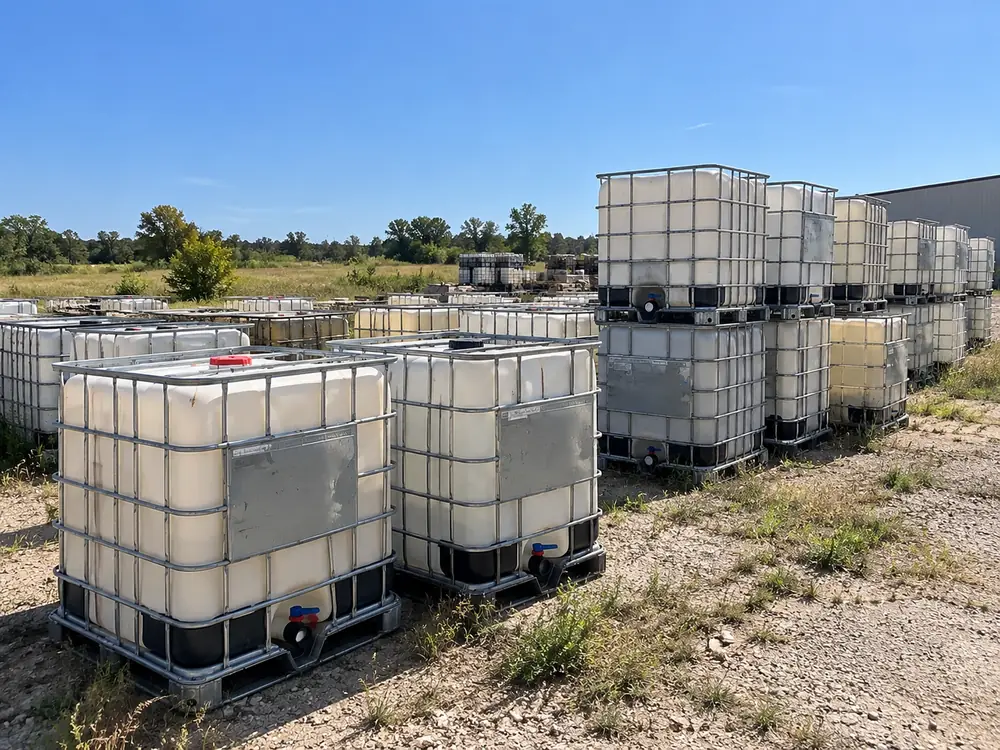
The containers in this photograph had all failed reuse twice
Stained walls, ghosting from a prior pigment, a bottle that still smelled after a full caustic cycle. By every commercial measure they were finished — and they are also watertight, forklift-ready 265-gallon vessels in frames rated for a tonne.
Last year the fabrication corner diverted 1,840 of them. It is the least profitable line in the business and the one we are least likely to drop.