Parts, fittings
and the small stuff that leaks
A tote that leaks is often a tote with a seal problem, not a failed container. Replacement valves, gaskets, lids and other parts are available through partner suppliers across the United States, subject to availability.
Request parts or ask what fits
Describe the tote, the thread, or just send what you measured. We pass your request to a partner supplier, who follows up with a quote.
Tell us what you have.
A partner supplier follows up.
Buying, selling, washing, hauling or recycling: one free, no-obligation request covers all of it. Partner suppliers set the price and availability.
Most IBC leaks are seal failures, not container failures. Before replacing a tote, replace the outlet gasket, the lid seal and the valve — a few parts cost far less than a new container. The standard North American composite IBC uses a 2-inch outlet valve on an S60x6 (63 mm buttress) thread with a 6-inch lid, but measure rather than assume.
Valves & fittings
Butterfly, ball, 2 inch and 3 inch, S60x6 adapters, camlocks, hose tails, reducers and how to identify a thread you do not recognise.
OpenDeep diveLids & gaskets
6-inch vented and solid lids, EPDM, Viton, silicone and PTFE seals, tamper-evident caps and a chemical compatibility table.
OpenDeep divePallets & cages
Steel, composite and timber pallets, cage sections, straightening and what makes a frame unfit to reuse.
OpenCommon IBC parts
The parts most often requested. Availability and pricing are by quote from partner suppliers.
| Part | Options | Typical use | Materials |
|---|---|---|---|
| Outlet valve, 2" | Butterfly, ball | Standard composite IBC | PP body, EPDM / Viton seat |
| Outlet valve, 3" | Butterfly, ball | 330 gal+ and high-viscosity | PP / PE body |
| Stainless ball valve | 2", 3" | Hot product, solvents, CIP | 304 / 316L, PTFE seat |
| S60x6 adapter | Male / female, hose tail | Thread conversion | PP, nylon, brass |
| Camlock adapter | A, B, C, D, E, F; 2", 3" | Quick-connect transfer | PP, aluminium, 316 |
| Hose tails & reducers | 3/4" to 3" | Pump and hose connection | PP, brass, stainless |
| Lid, 6" | Vented, solid, screw | Top closure | HDPE with new seal |
| Lid seal | Foam, EPDM, silicone | Top closure sealing | Foam, EPDM, silicone |
| Outlet gasket | Flat, O-ring, PTFE envelope | The usual cause of leaks | EPDM, Viton, silicone, PTFE |
| Dust cap | Tamper-evident, plain | Transit protection | PE |
| Pallet | Steel, composite, timber | Replacement / conversion | — |
| Cage section | Panel, upright, foot | Repair | Galvanised steel |
| Tote heater jacket | 120 V, 240 V | Winter viscosity, freeze protection | Insulated silicone element |
| Insulated cover | 275 / 330 gal | Frost and UV protection | Reflective PE / PVC |
| Spill pallet / bund | 1, 2, 4 tote | Secondary containment | PE |
| Level gauge | Sight tube, float | Inventory | PE / PP |
| Transfer pump | Diaphragm, drum, 12 V | Dispensing | PP / SS wetted parts |
Check the gasket first
When a tote leaks, the cause is often a flattened or chemically attacked outlet gasket, a worn valve seat or a damaged lid seal rather than the bottle itself. Those parts are small and replaceable; the bottle is not.
That is why this page exists. A gasket and a lid seal cost a small fraction of a replacement container, and fitting them is a short job with a strap wrench on a drained unit. If you run many totes, keep spare seals on hand so a leak does not take a container out of service.
Diagnosing it in two minutes
- Drained and dry, wipe the valve boss and the lower seam clean.
- Fill a few inches with water and leave it twenty minutes on a dry floor. A puddle at the valve is a gasket or seat; a damp patch on the wall is the bottle.
- Pressurise gently — a few psi only — and brush soapy water around the valve boss, the lid seat and the lower radius. Bubbles find what eyes do not.
- Check the gasket itself: hardened, shiny, cracked, swollen or permanently flattened all mean replace, regardless of whether it is leaking today.
Still leaking after new seals and a new valve? Then it is the bottle, and the question becomes rebottle or recycle.
| Cause | Where to look | Usual fix |
|---|---|---|
| Outlet gasket | Puddle at the valve | Replace the gasket |
| Valve seat wear | Drip from a closed valve | Replace the valve |
| Lid seal | Weeping at the top | Replace the lid seal |
| Bottle failure | Damp patch on the wall | Rebottle or replace |
Parts FAQ
What size is a standard IBC tote outlet?
The most common outlet on a North American composite IBC is a 2-inch valve on an S60x6 (63 mm buttress) thread, with a 6-inch lid on the top. Larger formats and some European-built units use 3-inch outlets, and stainless vessels typically use tri-clamp or threaded ball valves. Because there is no single universal standard, measure the thread crest-to-crest before ordering — the valve and fitting page walks through how.
Can I replace an IBC valve myself?
Yes, on a drained and depressurised container, and it is usually a short job with a strap wrench. Replace the gasket at the same time — a 'leaking valve' is often a flattened, hardened or chemically attacked gasket. Never attempt it on a container holding product, and never on one that held something you cannot identify.
Which gasket material should I use?
EPDM is the default: good with water, dilute acids and alkalis, glycols and many water-based products. Viton is for aromatics, chlorinated solvents, fuels, fats and higher temperatures. Silicone suits high-temperature food transfer but is poor with oils. PTFE-envelope gaskets handle almost everything chemically but need a flatter, better-maintained sealing face. Name the liquid in your request so the supplier can match the seal to it.
Are parts harvested from used totes worth buying?
Ask the supplier which parts are new and which are harvested. Lids, dust caps, cage sections and pallets can be reused if sound. For valves and gaskets, new is the safer choice: a harvested valve is a false economy: the body is fine but the seat has taken a service life of chemistry and compression set, and it will weep at the worst possible moment.
Can I request just a few parts?
Yes. Enter what you need, including single parts, and a partner supplier follows up with a quote. Minimums, availability and shipping are set by the supplier. If you run many totes, list the valves, gaskets, lids and caps you use, in your materials, so the request is easy to repeat.
Related pages
Part lines, grouped and specified
Common IBC part lines with options, materials and typical use. Availability, minimums and pricing are by quote from partner suppliers.
| Part | Group | Options | Materials | Typical use |
|---|---|---|---|---|
| 2" butterfly valve | Valves | EPDM, Viton, silicone seat | PP body | Standard composite IBC outlet |
| 3" butterfly valve | Valves | EPDM, Viton seat | PP body | Larger outlets and viscous product |
| 2" ball valve, full bore | Valves | EPDM, Viton seat | PP / PE body | Slurries, pastes, abrasives |
| 3" ball valve | Valves | EPDM, Viton seat | PP body | High-viscosity decanting |
| Stainless ball valve | Valves | 2", 3"; PTFE seat | 304 / 316L | Hot fill, solvents, CIP service |
| Fine-control ball valve | Valves | 2", lever or handwheel | PP | Controlled pail filling |
| Tri-clamp butterfly valve | Valves | 2", 3" | 316L, EPDM / PTFE | Sanitary stainless vessels |
| Gate valve | Valves | 2", 3" | Cast iron, PTFE seat | Legacy steel vessels only |
| S60x6 to 3/4" GHT | Adapters | Male / female | PP, nylon, brass | Garden hose connection |
| S60x6 to 2" NPT | Adapters | Male / female | PP, nylon | Pipe and pump connection |
| S60x6 to camlock | Adapters | Type A, F; 2" | PP, aluminum, 316 | Quick-connect transfer |
| S56x4 to S60x6 converter | Adapters | n/a | PP | Older and imported bottles |
| Camlock coupler | Adapters | Types A–F, DC, DP | PP, aluminum, 316 | Hose and pump halves |
| Hose tail / shank | Adapters | 3/4" to 3" | PP, brass, stainless | Hose clamping |
| Reducer / increaser | Adapters | 2"×3", 2"×1.5" | PP, aluminum | Matching an existing hose |
| 2.5" fire thread adapter | Adapters | NST / NH | Aluminum, brass | Fire-water draft points |
| Bulkhead fitting | Adapters | 1/2" to 2" | PP, EPDM gaskets | Through-wall on upcycled builds |
| 6" screw lid, vented | Closures | One-way, two-way vent | HDPE | Pumped discharge, off-gassing, outdoor |
| 6" screw lid, solid | Closures | n/a | HDPE | Sealed transport and storage |
| Tamper-evident dust cap | Closures | Plain, numbered | PE | Transit protection and evidence |
| Camlock dust plug / cap | Closures | DC, DP | PP, aluminum | Closing an unused half |
| Outlet gasket, flat | Seals | EPDM, Viton, silicone | Rubber compound to suit the liquid | The usual cause of a leak |
| Outlet gasket, O-ring | Seals | EPDM, Viton | Rubber compound to suit the liquid | Some valve patterns |
| PTFE envelope gasket | Seals | EPDM or silicone core | PTFE | Aggressive or mixed chemistry |
| Lid seal | Seals | Foam, EPDM, silicone | Rubber compound to suit the liquid | Second most degraded part |
| Cage, 275 gal | Structure | New or reused | Galvanized steel tube | Rebottling, racking, fabrication |
| Cage, 330 gal | Structure | New or reused | Galvanized steel tube | As above |
| Cage section | Structure | Panel, upright, foot | Galvanized steel | Repair |
| Steel pallet | Structure | New or repaired | Galvanized steel | The usual base on composite totes |
| Composite pallet | Structure | Reused or new | Molded plastic | Hygiene-sensitive environments |
| Timber pallet | Structure | New or reused | Softwood | Indoor, dry, cost-led |
| Spill pallet / bund | Handling | 1, 2 or 4 tote | PE | Secondary containment |
| Tote stand | Handling | Fixed, adjustable | Galvanized steel | Gravity head for decanting |
| Tote tipper frame | Handling | Manual | Steel | Draining the last heel |
| Transfer pump | Handling | Diaphragm, drum, 12 V | PP / SS wetted parts | Dispensing |
| Heater jacket | Temperature | 120 V, 240 V | Insulated heating element | Winter viscosity, freeze protection |
| Insulated cover | Temperature | 275 / 330 gal | Reflective PE / PVC | Frost and UV protection |
| UV / blackout cover | Temperature | 275 / 330 gal | UV-stable PE | Algae control, slows UV aging |
| Level gauge | Measurement | Sight tube, float | PE / PP | Inventory |
| Temperature strip | Measurement | Adhesive | n/a | Freeze and hot-fill monitoring |
| Stencil kit | Measurement | Custom wording | n/a | Fleet marking |
Open the group you need
Each list carries the same columns: options, materials, use and availability.
Valves — eight lines, body and seat combinations
| Part | Group | Options | Materials | Typical use |
|---|---|---|---|---|
| 2" butterfly valve | Valves | EPDM, Viton, silicone seat | PP body | Standard composite IBC outlet |
| 3" butterfly valve | Valves | EPDM, Viton seat | PP body | Larger outlets and viscous product |
| 2" ball valve, full bore | Valves | EPDM, Viton seat | PP / PE body | Slurries, pastes, abrasives |
| 3" ball valve | Valves | EPDM, Viton seat | PP body | High-viscosity decanting |
| Stainless ball valve | Valves | 2", 3"; PTFE seat | 304 / 316L | Hot fill, solvents, CIP service |
| Fine-control ball valve | Valves | 2", lever or handwheel | PP | Controlled pail filling |
| Tri-clamp butterfly valve | Valves | 2", 3" | 316L, EPDM / PTFE | Sanitary stainless vessels |
| Gate valve | Valves | 2", 3" | Cast iron, PTFE seat | Legacy steel vessels only |
Adapters and couplings — ten lines, thread conversions and camlocks
| Part | Group | Options | Materials | Typical use |
|---|---|---|---|---|
| S60x6 to 3/4" GHT | Adapters | Male / female | PP, nylon, brass | Garden hose connection |
| S60x6 to 2" NPT | Adapters | Male / female | PP, nylon | Pipe and pump connection |
| S60x6 to camlock | Adapters | Type A, F; 2" | PP, aluminum, 316 | Quick-connect transfer |
| S56x4 to S60x6 converter | Adapters | n/a | PP | Older and imported bottles |
| Camlock coupler | Adapters | Types A–F, DC, DP | PP, aluminum, 316 | Hose and pump halves |
| Hose tail / shank | Adapters | 3/4" to 3" | PP, brass, stainless | Hose clamping |
| Reducer / increaser | Adapters | 2"×3", 2"×1.5" | PP, aluminum | Matching an existing hose |
| 2.5" fire thread adapter | Adapters | NST / NH | Aluminum, brass | Fire-water draft points |
| Bulkhead fitting | Adapters | 1/2" to 2" | PP, EPDM gaskets | Through-wall on upcycled builds |
| Designation | Male crest OD | Pitch | Six pitches span | Where you see it | Adapts to |
|---|---|---|---|---|---|
| S60x6 (coarse buttress) | ≈ 60–63 mm | 6 mm | 36 mm | Most North American composite IBCs, 2" outlet | NPT, camlock and hose tail adapters |
| S56x4 (fine) | ≈ 56 mm | 4 mm | 24 mm | Older and some imported bottles | NPT adapters, or a converter to S60x6 |
| S70x6 | ≈ 70 mm | 6 mm | 36 mm | Some imported bottles | 2" NPT via adapter |
| 3" outlet thread | Varies, measure it | Varies | Measure | Larger outlets on some units | Check with the valve maker |
| 2" NPT | ≈ 60 mm | 11.5 TPI | 13.2 mm | Steel and stainless vessels | Standard pipe fittings |
| 2" tri-clamp | 64 mm ferrule | n/a | n/a | Sanitary stainless IBCs | Sanitary fittings |
| 3" tri-clamp | 91 mm ferrule | n/a | n/a | Larger stainless vessels | Sanitary fittings |
| Type | Half | End connection | Typical use on a tote |
|---|---|---|---|
| A | Male adapter | Female thread | Screws onto a male-threaded valve outlet |
| B | Female coupler | Male thread | Threads into a pump inlet |
| C | Female coupler | Hose shank | The hose end you clamp on |
| D | Female coupler | Female thread | Pairs with a male-threaded port |
| E | Male adapter | Hose shank | Hose end that plugs into a coupler |
| F | Male adapter | Male thread | Threads into a female-threaded port |
| DC | Dust cap | n/a | Closes a male adapter in transit |
| DP | Dust plug | n/a | Closes a female coupler in transit |
Closures — lids, caps and plugs
| Part | Group | Options | Materials | Typical use |
|---|---|---|---|---|
| 6" screw lid, vented | Closures | One-way, two-way vent | HDPE | Pumped discharge, off-gassing, outdoor |
| 6" screw lid, solid | Closures | n/a | HDPE | Sealed transport and storage |
| Tamper-evident dust cap | Closures | Plain, numbered | PE | Transit protection and evidence |
| Camlock dust plug / cap | Closures | DC, DP | PP, aluminum | Closing an unused half |
Seals — gaskets and lid seals, with the compatibility matrix
| Part | Group | Options | Materials | Typical use |
|---|---|---|---|---|
| Outlet gasket, flat | Seals | EPDM, Viton, silicone | Rubber compound to suit the liquid | The usual cause of a leak |
| Outlet gasket, O-ring | Seals | EPDM, Viton | Rubber compound to suit the liquid | Some valve patterns |
| PTFE envelope gasket | Seals | EPDM or silicone core | PTFE | Aggressive or mixed chemistry |
| Lid seal | Seals | Foam, EPDM, silicone | Rubber compound to suit the liquid | Second most degraded part |
| Medium | EPDM | Viton (FKM) | Silicone | PTFE | Usual first choice |
|---|---|---|---|---|---|
| Water, potable & process | Excellent | Excellent | Excellent | Excellent | EPDM |
| Dilute acids (<10%) | Good | Excellent | Fair | Excellent | EPDM |
| Concentrated acids | Poor | Good | Poor | Excellent | PTFE |
| Caustic soda, alkalis | Excellent | Fair | Fair | Excellent | EPDM |
| Liquid fertilizer, UAN | Excellent | Good | Fair | Excellent | EPDM |
| Glycols, coolants, de-icer | Excellent | Good | Good | Excellent | EPDM |
| Surfactants, detergents | Excellent | Good | Good | Excellent | EPDM |
| Edible oils, fats | Poor | Excellent | Poor | Excellent | Viton |
| Mineral oils | Poor | Excellent | Poor | Excellent | Viton |
| Aromatic solvents | Poor | Excellent | Poor | Excellent | Viton |
| Chlorinated solvents | Poor | Good | Poor | Excellent | Viton / PTFE |
| Ketones (acetone, MEK) | Fair | Poor | Poor | Excellent | PTFE |
| Alcohols | Good | Good | Good | Excellent | EPDM |
| Fuels, diesel, kerosene | Poor | Excellent | Poor | Excellent | Viton |
| Juice & syrup concentrate | Excellent | Excellent | Excellent | Excellent | EPDM |
| Brine, pickling liquor | Good | Excellent | Fair | Excellent | Viton |
| Hot fill 140–180°F | Fair | Excellent | Excellent | Excellent | Viton / silicone |
| Hydrogen peroxide (dilute) | Good | Fair | Fair | Excellent | EPDM / PTFE |
| Sodium hypochlorite | Good | Good | Fair | Excellent | EPDM |
| Steam / CIP chemistry | Excellent | Fair | Good | Excellent | EPDM |
| Outdoor weathering & ozone | Excellent | Good | Excellent | Excellent | EPDM |
Structure — cages, pallets and sections
| Part | Group | Options | Materials | Typical use |
|---|---|---|---|---|
| Cage, 275 gal | Structure | New or reused | Galvanized steel tube | Rebottling, racking, fabrication |
| Cage, 330 gal | Structure | New or reused | Galvanized steel tube | As above |
| Cage section | Structure | Panel, upright, foot | Galvanized steel | Repair |
| Steel pallet | Structure | New or repaired | Galvanized steel | The usual base on composite totes |
| Composite pallet | Structure | Reused or new | Molded plastic | Hygiene-sensitive environments |
| Timber pallet | Structure | New or reused | Softwood | Indoor, dry, cost-led |
| Factor | Steel | Composite | Timber |
|---|---|---|---|
| Outdoor life | Long while the zinc holds | Good, UV-dependent | Poor; rots when left wet |
| Forklift tolerance | Excellent | Fair; decks can crack | Fair; bearers can split |
| Pallet-jack entry | Often four-way | Often four-way, check depth | Often two-way only |
| Repairable | Often, by a repair shop | No | Partly |
| Washability | Good | Excellent | Poor |
| Pest and splinter risk | None | None | Real |
| Rot and delamination | None | None | Common |
| ISPM 15 on export | Not applicable | Not applicable | Generally required for solid wood |
| Hygiene-sensitive use | Acceptable | Preferred | Avoid |
| Relative cost new | Usually highest | Usually middle | Usually lowest |
Handling — bunds, stands, tippers and pumps
| Part | Group | Options | Materials | Typical use |
|---|---|---|---|---|
| Spill pallet / bund | Handling | 1, 2 or 4 tote | PE | Secondary containment |
| Tote stand | Handling | Fixed, adjustable | Galvanized steel | Gravity head for decanting |
| Tote tipper frame | Handling | Manual | Steel | Draining the last heel |
| Transfer pump | Handling | Diaphragm, drum, 12 V | PP / SS wetted parts | Dispensing |
Temperature — heater jackets, insulated and UV covers
| Part | Group | Options | Materials | Typical use |
|---|---|---|---|---|
| Heater jacket | Temperature | 120 V, 240 V | Insulated heating element | Winter viscosity, freeze protection |
| Insulated cover | Temperature | 275 / 330 gal | Reflective PE / PVC | Frost and UV protection |
| UV / blackout cover | Temperature | 275 / 330 gal | UV-stable PE | Algae control, slows UV aging |
Measurement and marking
| Part | Group | Options | Materials | Typical use |
|---|---|---|---|---|
| Level gauge | Measurement | Sight tube, float | PE / PP | Inventory |
| Temperature strip | Measurement | Adhesive | n/a | Freeze and hot-fill monitoring |
| Stencil kit | Measurement | Custom wording | n/a | Fleet marking |
The shelf worth holding
For an operator running many totes, a small set of spares can keep containers in service that would otherwise be replaced.
- Outlet gaskets in the elastomer your product actually needs — not just the one that came with the container.
- Lid seals, among the cheapest parts on the unit and often degraded.
- Two spare valves, so a seat failure is a quick swap rather than a wait for parts.
- Tamper-evident dust caps, which tell you at a glance whether a valve has been opened.
- A strap wrench. Not a pipe wrench, which distorts the valve body and creates the next leak.
- A bright inspection lamp for backlighting walls — the single most useful quality check available.
- pH strips if you wash in-house, for final-rinse verification.
- UV covers for anything stored outdoors. Sunlight is usually what ages a bottle.
What size is a standard outlet?
2-inch valve on an S60x6 (63 mm buttress) thread, with a 6-inch lid. Measure the crest diameter to be sure — S56x4 looks similar.
Can I change a valve myself?
Yes, on a drained and depressurised container, with a strap wrench. Replace the gasket at the same time.
Which gasket material?
EPDM for water-based chemistry, Viton for aromatics and fats, silicone for some hot transfer duties, PTFE when nothing else is acceptable. Confirm with the supplier for your liquid.
Are harvested parts OK?
Lids, caps, cage sections and pallets can be reused if sound. For valves and gaskets, choose new — a harvested seat can weep at the worst moment.
Can I fit a 3-inch valve to a 2-inch outlet?
No. The moulded boss sets the outlet size. A downstream adapter gets you hose compatibility, not more flow.
How do I get parts?
Request them through the form. A partner supplier follows up with a quote, including availability and shipping.
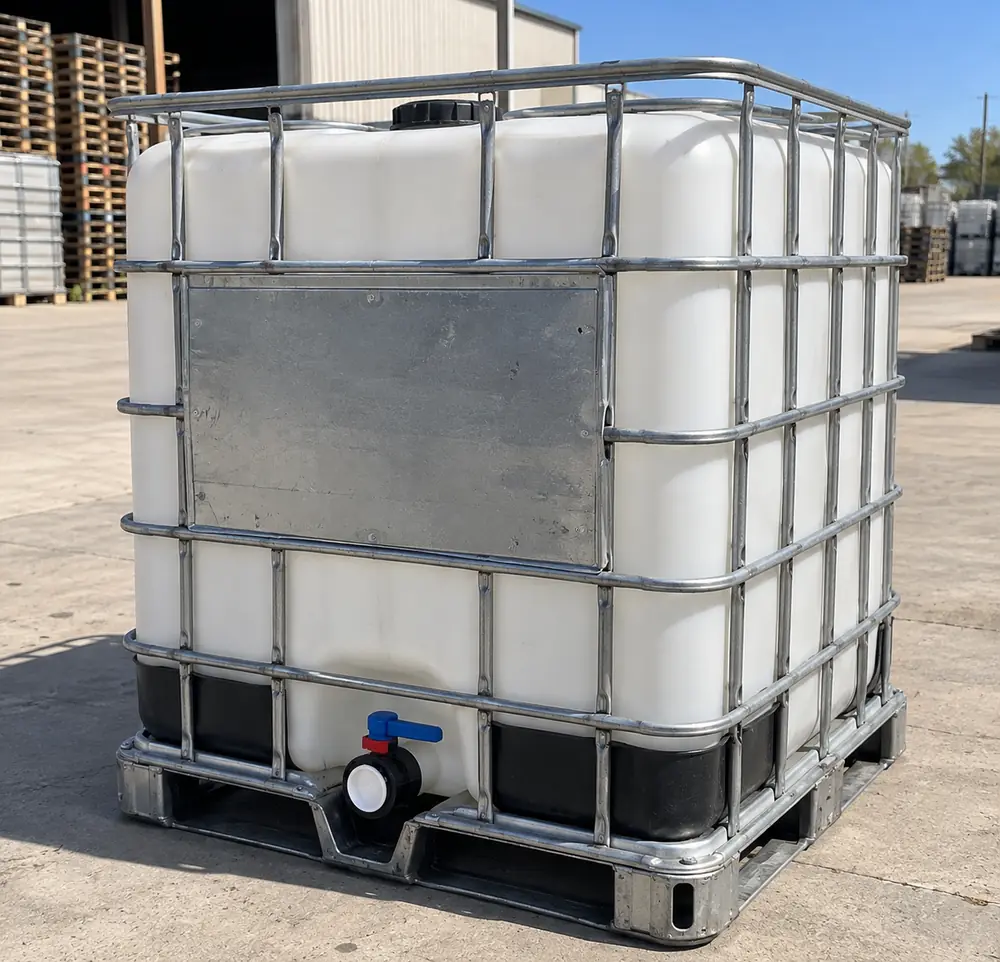
Everything in this photograph is replaceable except one thing
The valve, the gasket behind it, the lid, the lid seal, the dust cap, the cage sections and the pallet are all replaceable parts, available through partner suppliers.
The moulded valve boss is the exception. Star crazing there — usually from a pump or a rigid pipe run cantilevered off the outlet — cannot be repaired, and it is one of the most avoidable ways to write off an otherwise sound container.