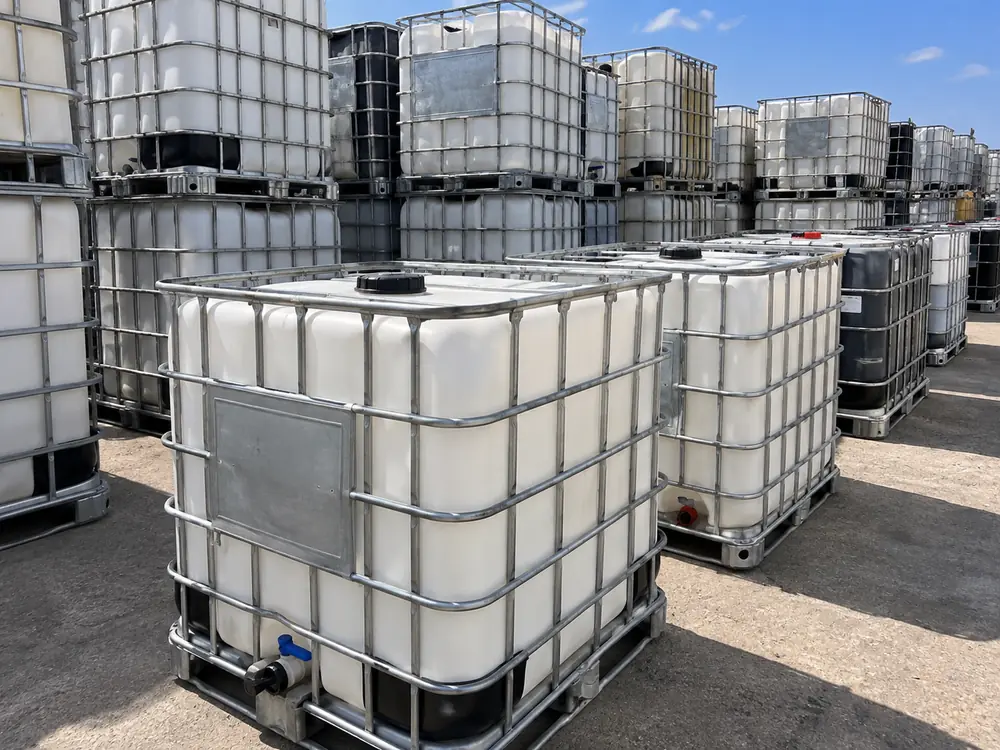
Rebottled totes:
new inside, reused outside
A brand-new blow-moulded HDPE bottle in a straightened, reclaimed galvanised cage. You get a virgin contact surface; 62 lb of sound steel stays out of the scrap stream. This is the most under-used idea in bulk packaging.
Quote rebottled totes
Tell us the liquid, the quantity and whether anything downstream gets audited. Build time is 3–7 days.
Tell us what you have.
We will tell you what it is worth.
Buying, selling, washing, hauling or recycling — one form covers all of it. Replies come from a specialist in York, PA, by email, inside one business day.
Prefer plain email? Write to info@ibctotesreco.com — include your ZIP, quantity and what the totes last held.
A rebottled IBC tote is a new virgin HDPE bottle fitted into a reclaimed, straightened galvanised cage and inspected pallet, with a new valve, new FDA-compliant gaskets and a new lid. It costs roughly 55–65% of a new unit, carries a contact surface that has never held anything, and avoids remaking the 62 lb of steel that makes up a third of the container's embodied carbon.
Why this exists
Two things fail at completely different rates in a composite IBC. The bottle is a consumable: UV embrittles it, pigments stain it, resins and adhesives plasticise into the wall, and after one hard service life it may be unfit for anything sensitive. The cage is structural steel. Kept square and free of impact damage, it will outlast three or four bottles without complaint.
The industry habit of scrapping both at the same time is pure waste, and it is also why used-tote buyers so often get offered a stained bottle when what they actually needed was a clean one. Rebottling separates the two decisions.
What we do to the cage
- Frame gauge check. Cages out of square by more than a defined tolerance are rejected rather than forced — a twisted cage will not stack safely whatever you do to it.
- Press-jig straightening. Minor racking and bowed verticals are corrected on a jig, not with a hammer and optimism.
- Weld inspection. Every node is checked; cracked or previously field-welded nodes send the cage to steel recovery.
- Zinc repair. Abraded galvanising is cold-zinc repaired so the cage does not become a rust problem on your yard in two winters.
- Pallet decision. Steel pallets are repaired and reused; composite and timber are probed for rot and delamination and replaced if they fail. See pallet types compared.
When rebottled is the right answer
- Food, beverage, potable water, cosmetics, nutraceuticals.
- Anything where a customer or certifier will ask about prior contents.
- Light-coloured or clarity-sensitive products where staining matters visually.
- Replacing a fleet gradually without paying new-unit prices.
- Any case where reconditioning would be a compromise you would have to explain later.
Rebottled against the alternatives
The honest comparison, including where rebottling loses.
| New | Rebottled | Reconditioned Grade A | Reconditioned Grade B | |
|---|---|---|---|---|
| Contact surface | Virgin | Virgin | Washed, edible-prior | Washed, industrial-prior |
| Cage | New | Reclaimed | Reclaimed | Reclaimed |
| Prior-contents question | None | None | Documented | Documented |
| Food / potable | Yes | Yes | Yes, with records | No |
| Embodied CO₂e | ≈ 410 lb | ≈ 182 lb | ≈ 34 lb | ≈ 34 lb |
| Virgin resin | 118 lb | 47 lb | 0 lb | 0 lb |
| Cost vs new | 100% | 55–65% | 35–45% | 25–32% |
| Lead time | 1–2 weeks | 3–7 days | Ex-stock | Ex-stock |
| Best when | Spec demands virgin cage | Virgin surface, sane budget | Food with provenance | General industrial |
Rebottling loses on exactly two counts: it costs more than reconditioning, and it cannot satisfy a specification that demands a new cage. Everywhere else it is the better environmental and commercial answer than buying new. The arithmetic is here.
Rebottled tote FAQ
Is a rebottled IBC tote as good as new?
The part your product touches is new — the bottle is a virgin blow-moulded HDPE vessel that has never held anything. What is reused is the structure around it: a galvanised cage straightened on a press jig and a pallet inspected for rot, delamination and weld integrity. For almost every application the performance is indistinguishable from new; the exception is a purchasing specification that explicitly requires a new cage, which some audited supply chains do.
Why not just buy new?
Because roughly 62 lb of sound galvanised steel per unit does not need remaking, and you would be paying for it twice. Rebottling typically lands at 55–65% of new-unit cost while retaining about 42% of the material and 100% of the steel. It is the single best compromise in bulk packaging between a virgin contact surface and not wasting a perfectly good cage.
Can rebottled totes be used for food and potable water?
Yes — that is their main reason for existing. The bottle is virgin FDA-compliant HDPE, and we fit new FDA-compliant gaskets and a new lid. Because there is no prior-contents question to answer, rebottled units are the cleanest path through a food-safety or potable-water audit without buying new.
Do rebottled totes carry a UN marking?
A rebottled unit is a remanufactured packaging. Where the combination of new bottle and reclaimed cage matches an approved design type and passes the required testing, it is marked accordingly with the remanufacturer's code and date. If you are shipping DOT-regulated liquids, tell us on the enquiry so the unit is built and marked to the right design type from the start rather than retrofitted.
How long does rebottling take?
Three to seven working days for standard 275 and 330 gallon formats from stock cages, longer if you need a specific pallet type or a non-standard valve and gasket combination. Truckload quantities are usually built in a single run so that the cage population is consistent.
What happens to the bottle that came out?
It goes to regrind — cut, washed and granulated into HDPE feedstock — because by definition it failed reuse twice before the unit was selected for rebottling. The cage and pallet are what we were after. Documentation of that route is available as a diversion certificate.
Related pages
Nine hundred builds, measured
What proportion of cages pass the jig, what gets replaced, what the build costs and what it saves.
| Metric | Figure | Note |
|---|---|---|
| Cages offered to the jig | 100% | Every failed-bottle unit is assessed |
| Cages passing the frame gauge | ≈ 71% | Under 1/4" diagonal difference after jig |
| Cages rejected for geometry | ≈ 18% | Over 1/2" twist, or will not come back |
| Cages rejected for nodes or field welds | ≈ 11% | Immediate steel recovery |
| Pallets reused as-is | ≈ 62% | Steel and composite mostly |
| Pallets repaired then reused | ≈ 18% | Steel only |
| Pallets replaced | ≈ 20% | Almost all timber |
| Build time, stock cages | 3–7 days | Longer for non-standard pallets or valves |
| Cost versus new unit | 55–65% | Truckload quantities, ex-freight |
| Embodied CO₂e versus new | ≈ 44% | ≈ 182 lb against ≈ 410 lb |
| Steel kept out of scrap, per unit | 62 lb | Cage only; more with a steel pallet |
| Virgin resin, per unit | 47 lb | Against 118 lb for a new unit |
Where rebottling sits between reuse and new
| Route | CO₂e | Fresh water | Virgin resin | Virgin steel |
|---|---|---|---|---|
| New unit | ≈ 410 lb | ≈ 290 gal | 118 lb | 62 lb |
| Rebottled | ≈ 182 lb | ≈ 120 gal | 47 lb | 0 lb |
| Reconditioned | ≈ 34 lb | ≈ 31 gal | 0 lb | 0 lb |
| Repurposed Grade C | ≈ 11 lb | ≈ 14 gal | 0 lb | 0 lb |
| Input | Quantity | Factor or source |
|---|---|---|
| Virgin HDPE resin | 118 lb / 53.5 kg | 1.8 kg CO₂e/kg |
| Blow moulding energy | 53.5 kg part | 0.4 kg CO₂e/kg |
| Hot-dip galvanised steel | 106 lb / 48 kg | 2.5 kg CO₂e/kg |
| Cage fabrication & assembly | 48 kg | 0.3 kg CO₂e/kg |
| Mechanical HDPE recycling | per kg processed | 0.5 kg CO₂e/kg |
| Fresh water per wash | 31 gal / unit | Metered |
| Natural gas, water heating | per programme | Metered per bay per shift |
| Electricity | per unit | Renewable tariff + 48 kW array |
| New valve, gaskets, lid | ≈ 3 lb | ≈ 8 lb CO₂e |
What goes into a rebottled unit
New bottle, new wetted components, reclaimed structure — and a documented check on every reused part.
| Factor | Steel | Composite | Timber |
|---|---|---|---|
| Typical weight | ≈ 44 lb | ≈ 31 lb | ≈ 38 lb |
| Outdoor life | Indefinite with zinc repair | Good, UV-dependent | 2–4 winters |
| Forklift tolerance | Excellent | Fair — decks crack | Fair — bearers split |
| Pallet-jack entry | Four-way, usually | Four-way, check depth | Often two-way only |
| Repairable | Yes — welded, re-zinced | No | Partly |
| Washability | Good | Excellent | Poor |
| Pest / splinter risk | None | None | Real |
| ISPM-15 on export | Not applicable | Not applicable | Required |
| Hygiene-sensitive use | Acceptable | Preferred | Avoid |
| Cost new | Highest | Middle | Lowest |
| Replacement rate at our bench | Low | Low–moderate | Highest by far |
| Our default on rebottled units | Yes | On request | No |
| Medium | EPDM | Viton (FKM) | Silicone | PTFE | We would fit |
|---|---|---|---|---|---|
| Water, potable & process | Excellent | Excellent | Excellent | Excellent | EPDM |
| Dilute acids (<10%) | Good | Excellent | Fair | Excellent | EPDM |
| Concentrated acids | Poor | Good | Poor | Excellent | PTFE |
| Caustic soda, alkalis | Excellent | Fair | Fair | Excellent | EPDM |
| Liquid fertiliser, UAN | Excellent | Good | Fair | Excellent | EPDM |
| Glycols, coolants, de-icer | Excellent | Good | Good | Excellent | EPDM |
| Surfactants, detergents | Excellent | Good | Good | Excellent | EPDM |
| Edible oils, fats | Poor | Excellent | Poor | Excellent | Viton |
| Mineral oils | Poor | Excellent | Poor | Excellent | Viton |
| Aromatic solvents | Poor | Excellent | Poor | Excellent | Viton |
| Chlorinated solvents | Poor | Good | Poor | Excellent | Viton / PTFE |
| Ketones (acetone, MEK) | Fair | Poor | Poor | Excellent | PTFE |
| Alcohols | Good | Good | Good | Excellent | EPDM |
| Fuels, diesel, kerosene | Poor | Excellent | Poor | Excellent | Viton |
| Juice & syrup concentrate | Excellent | Excellent | Excellent | Excellent | FDA EPDM |
| Brine, pickling liquor | Good | Excellent | Fair | Excellent | Viton |
| Hot fill 140–180°F | Fair | Excellent | Excellent | Excellent | Viton / silicone |
| Hydrogen peroxide (dilute) | Good | Fair | Fair | Excellent | EPDM / PTFE |
| Sodium hypochlorite | Good | Good | Fair | Excellent | EPDM |
| Steam / CIP chemistry | Excellent | Fair | Good | Excellent | EPDM |
| Outdoor weathering & ozone | Excellent | Good | Excellent | Excellent | EPDM |
Five things to tell us before a build starts
Whether you ship a regulated liquid
A rebottled unit is a remanufactured packaging. Built and marked to the right design type from the start is straightforward; retrofitting a marking decision onto a finished build is not.
The actual product, by name
The bottle is virgin either way. The gasket and valve seat have to match your chemistry, and that is the part that fails first.
Your lowest equipment rating
Rebottled units are available in 275 and 330. If a beam level or a lift gate is marginal, the 275 is the only safe answer.
Whether the base gets washed
We fit steel by default for durability. Food and pharma environments usually want composite — it washes, does not splinter and weighs less.
Your date, early
Three to seven days from stock cages. A slot booked in July costs the same as one booked in September and lands on the day you asked for.
New inside, reused outside
The cages in this photograph have each carried a bottle before. Straightened on a press jig against a frame gauge, cold-zinc repaired where the galvanising was abraded, every weld node walked for rust blooming — and then fitted with a virgin blow-moulded HDPE bottle that has never held anything.
Roughly 71% of the cages offered to the jig pass it. The 18% that are out of square beyond half an inch and the 11% with cracked or previously field-welded nodes go to steel recovery instead, because a frame that will not stack safely is scrap no matter how it looks from across a yard.