The IBC size chart,
with the exceptions written down.
Nominal capacity, usable capacity, footprint, height, tare, filled weight and valve thread for the common IBC formats, with notes on where units differ.
Need a format that is not in the table?
Tell us the volume and the constraint, such as a doorway, rack beam or trailer height, and we will pass your request to a partner supplier.
Tell us what you have.
A partner supplier follows up.
Buying, selling, washing, hauling or recycling: one free, no-obligation request covers all of it. Partner suppliers set the price and availability.
A standard 275-gallon composite IBC is about 48 × 40 × 46 inches, about 137 lb empty and about 2,347 lb filled with 265 usable gallons of water, with a 2-inch S60x6 outlet. A 330-gallon unit has the same 48 × 40 footprint but stands about 53 inches tall and weighs about 2,834 lb filled. Both match the standard GMA pallet footprint, which is why they fit normal racking, dock plates and trailers. Usable capacity is a few percent below nominal.
| Format | Nominal | Usable | L × W × H | Tare (steel base) | Gross, water | Outlet | Lid | Stack filled |
|---|---|---|---|---|---|---|---|---|
| 275 gal standard | 275 gal / 1,041 L | ≈ 265 gal | 48 × 40 × 46" | ≈ 137 lb | ≈ 2,347 lb | 2" S60x6 | 6" screw | Per plate |
| 330 gal standard | 330 gal / 1,249 L | ≈ 320 gal | 48 × 40 × 53" | ≈ 165 lb | ≈ 2,834 lb | 2" S60x6 | 6" screw | Per plate |
| 550 gal | 550 gal / 2,082 L | Varies by maker | Varies; footprint often exceeds 48 × 40" | Varies by maker | Varies by maker | 2" or 3" | 6" screw or similar | Per plate |
| Stainless 275 gal | 275 gal / 1,041 L | Varies by maker | Often near 48 × 40"; height varies | Varies by maker | Varies by maker | 2" or 3" tri-clamp or NPT | Manway | Per plate |
| Stainless 330 gal | 330 gal / 1,249 L | Varies by maker | Often near 48 × 40"; height varies | Varies by maker | Varies by maker | 2" or 3" tri-clamp or NPT | Manway | Per plate |
Gross figures use usable capacity and water at 8.34 lb/gal. For a denser product, multiply the liquid weight by your specific gravity: a 275-gallon tote of 1.35 SG liquid is about 3,121 lb and may exceed a light-duty rack beam or a pallet jack rating. Stack limits are set by the marking on each unit. Other sizes exist, including mini totes and 350- and 400-gallon units, and their dimensions vary by maker.
Work backwards from whatever is tightest
Nobody buys a tote by volume alone. Something is always the binding constraint — switch between them below.
| Route element | Plan for at least | Notes |
|---|---|---|
| Door, pallet jack, 40" side leading | 42" | Allow room to turn on both sides |
| Door, pallet jack, 48" side leading | 50" | Straight through only |
| Height, 275 gal standard | 48" | 46" plus pallet jack lift |
| Height, 330 gal | 56" | 53" plus lift |
| Corridor turn, 90° | Measure it | The diagonal is the real limit |
| Door, forklift carrying | Measure it | Mast and operator clearance |
| Lift gate | Check the rating | Compare it with the filled weight |
| Freight elevator | Check size and rating | Compare them with the filled unit |
| Configuration | Load per beam level | Typical rating needed |
|---|---|---|
| One 275 gal, filled with water | ≈ 2,347 lb | 3,000 lb |
| Two 275 gal, filled with water | ≈ 4,694 lb | 5,000 lb |
| Two 330 gal, filled with water | ≈ 5,668 lb | 6,000 lb |
| Two 275 gal at 1.35 SG | ≈ 6,242 lb | 6,500 lb |
| Beam pair width for two units | 96" clear | Standard |
| Beam depth | Per rack maker | Ask about pallet overhang |
| Clear height per level, 275 std | 52" | Allows 46" + lift clearance |
| Clear height per level, 330 | 59" | Check sprinkler clearance |
| Vehicle | Single tier | Two tier | Weight, single tier | Note |
|---|---|---|---|---|
| 48 ft flatbed | 28 | 56 | 3,836 lb | Empties are tall and light, so strap every unit |
| 53 ft trailer | 30 | 60 | 4,110 lb | Needs a dock or lift gate |
| 26 ft straight truck | 12 | — | 1,644 lb | Check interior height before stacking; lift gate rating governs |
| 16 ft box truck | 8 | — | 1,096 lb | Check interior width at the wheel wells |
| 20 ft shipping container | 8 | — | 1,096 lb | Door height rules out loading two high |
| 40 ft shipping container | 18 | — | 2,466 lb | Floor-loaded, blocked and braced |
| Pickup bed | 1 | — | 137 lb | Measure the bed; strap to the bed, not the cage top |
| Cargo van | 1 | — | 137 lb | Check door width and interior height |
| Product behavior | Headspace | Why |
|---|---|---|
| Water, stable at ambient | A little | Minimal expansion |
| Stored outdoors, freeze risk | Plenty, or drain it | Water expands about 9% on freezing |
| Thermally expanding (solvents, oils) | More than for water | Allow for temperature swings |
| Fermenting or off-gassing | Generous | Plus a vented lid |
| Hot-filled | More than for water | Cooling can pull a vacuum, so vent it |
| Foaming on transfer | Generous | Avoid overflow at the lid |
| Regulated liquid | As required | Check current regulations |
Companion references
Each of these exists because the master table above cannot hold it without becoming unreadable.
275 vs 330 gallon
Same footprint, seven more inches, 55 more usable gallons. When the bigger one is a mistake.
OpenWeights & footprints
Tare, gross, specific-gravity math and rack beam planning.
OpenValve & fitting sizes
Outlet threads, how to measure them, and adapter chains.
OpenUN marking guide
Read a plate line by line: the design code, the letter, the date and the limits.
OpenPallet types compared
Steel, composite and timber: handling, hygiene, export and repairability.
OpenInteractiveTote Studio
Build a spec against your constraints and send it as a quote request.
Open“275 gallon” is a market name, not a measurement.
It sits close to the 1,000-liter IBC used in much of the world. The useful number for planning is usable capacity, about 265 gallons, and for anything that expands, off-gasses or might freeze, less again. Build your process around usable volume.
Dimension FAQ
What are the dimensions of a 275 gallon IBC tote?
A standard 275-gallon composite IBC is about 48 inches long by 40 inches wide by 46 inches tall, on the same 48 by 40 inch footprint as a standard GMA pallet. Tare is about 137 lb on a steel base, and a tote holding about 265 usable gallons of water weighs about 2,347 lb. Figures vary a little by maker.
How tall is a 330 gallon IBC tote?
About 53 inches, on the same 48 by 40 inch footprint as a 275. That is the key practical fact about the 330: it does not take more floor space, only more headroom. Tare is about 165 lb, and about 320 usable gallons of water brings it to about 2,834 lb.
Why does a 275 gallon tote not hold 275 gallons?
Nominal capacity is the full volume of the bottle. Usable capacity is lower because you need headspace for expansion and because the outlet sits slightly above the floor of the bottle. Plan on about 265 usable gallons in a 275 and about 320 in a 330, and leave more room for anything that expands or off-gasses.
Will an IBC tote fit through a standard doorway?
Usually not. A 40-inch width will not pass through a 36-inch residential door. It will pass through a wide double door or a roll-up door. Measure the narrowest point of the whole route, including corners, not just the door.
How many IBC totes fit on a pallet rack beam?
Two across a standard 96-inch beam pair is the usual layout. The limit is almost always beam capacity rather than space: two 275-gallon totes of water come to about 4,694 lb on one level, which exceeds many light-duty rack configurations. Check the rack's capacity plate before loading.
Are all IBC totes 48 by 40 inches?
Most North American composite 275 and 330 gallon IBCs are, because that matches the GMA pallet footprint and so standard racking, dock plates and trailers. Larger units, such as 550-gallon totes, and some stainless vessels use their own footprints. Check the specific unit if racking or trailer loading is tight.
Related pages
Specific gravity is the number that decides what fits
Filled weight = tare + (usable gallons × 8.34 lb × specific gravity). Use usable, not nominal, and compare the answer against the lowest rating in your chain.
| Product | Typical SG | 275 gal filled | 330 gal filled |
|---|---|---|---|
| Acetone | 0.79 | 1,883 lb | 2,273 lb |
| Ethanol | 0.79 | 1,883 lb | 2,273 lb |
| Kerosene | 0.81 | 1,927 lb | 2,327 lb |
| Diesel fuel | 0.85 | 2,016 lb | 2,433 lb |
| Mineral oil | 0.88 | 2,082 lb | 2,514 lb |
| Biodiesel B100 | 0.88 | 2,082 lb | 2,514 lb |
| Canola oil | 0.91 | 2,148 lb | 2,594 lb |
| Soybean or olive oil | 0.92 | 2,170 lb | 2,620 lb |
| Water | 1.00 | 2,347 lb | 2,834 lb |
| Vinegar | 1.01 | 2,369 lb | 2,860 lb |
| Milk | 1.03 | 2,413 lb | 2,914 lb |
| Propylene glycol | 1.04 | 2,436 lb | 2,941 lb |
| Apple cider | 1.05 | 2,458 lb | 2,967 lb |
| Urea solution (DEF) | 1.09 | 2,546 lb | 3,074 lb |
| Ethylene glycol | 1.11 | 2,590 lb | 3,127 lb |
| Hydrogen peroxide 35% | 1.13 | 2,634 lb | 3,181 lb |
| Hydrochloric acid 31% | 1.16 | 2,701 lb | 3,261 lb |
| Salt brine 23% | 1.17 | 2,723 lb | 3,287 lb |
| Sodium hypochlorite 12% | 1.21 | 2,811 lb | 3,394 lb |
| Glycerine | 1.26 | 2,922 lb | 3,528 lb |
| Sulfuric acid 35% | 1.26 | 2,922 lb | 3,528 lb |
| Sodium hydroxide 25% | 1.27 | 2,944 lb | 3,554 lb |
| UAN 28 | 1.28 | 2,966 lb | 3,581 lb |
| Calcium chloride 30% | 1.28 | 2,966 lb | 3,581 lb |
| Latex paint | 1.30 | 3,010 lb | 3,634 lb |
| UAN 32 fertilizer | 1.32 | 3,054 lb | 3,688 lb |
| Liquid sugar or maple syrup | 1.33 | 3,076 lb | 3,715 lb |
| Juice concentrate (70 Brix) | 1.35 | 3,121 lb | 3,768 lb |
| High-fructose corn syrup | 1.38 | 3,187 lb | 3,848 lb |
| Liquid starter 10-34-0 | 1.38 | 3,187 lb | 3,848 lb |
| Molasses or honey | 1.42 | 3,275 lb | 3,955 lb |
| Ferric chloride 40% | 1.42 | 3,275 lb | 3,955 lb |
| Potassium hydroxide 45% | 1.46 | 3,364 lb | 4,061 lb |
| Sodium hydroxide 50% | 1.52 | 3,496 lb | 4,222 lb |
| Phosphoric acid 75% | 1.58 | 3,629 lb | 4,382 lb |
| Sulfuric acid 93% | 1.83 | 4,181 lb | 5,049 lb |
| Configuration | Load per beam level | Rating needed |
|---|---|---|
| One 275 gal, water | 2,347 lb | 3,000 lb level |
| One 275 gal, SG 1.3 | 3,010 lb | 3,500 lb level |
| Two 275 gal, water | 4,694 lb | 5,000 lb level |
| Two 275 gal, SG 1.3 | 6,020 lb | 6,500 lb level |
| Two 275 gal, SG 1.5 | 6,904 lb | 7,500 lb level |
| One 330 gal, water | 2,834 lb | 3,000 lb level |
| One 330 gal, SG 1.3 | 3,634 lb | 4,000 lb level |
| Two 330 gal, water | 5,668 lb | 6,000 lb level |
| Two 330 gal, SG 1.3 | 7,268 lb | 7,500 lb level |
A 275-gallon tote of 50% caustic comes to about 3,496 lb against about 2,347 lb for water. That difference is larger than the gap between a 275 and a 330, so density can matter more than format. Check any filled weight against the maximum gross mass on the plate too.
Threads, couplings and parts
There is no single universal IBC thread, which is why so many fittings ordered online do not fit. Measure the crest diameter and the distance across seven crests, then pick from the table.
Outlet thread identification, with pitch and crest diameter
| Designation | Male crest OD | Pitch | Six pitches span | Where you see it | Adapts to |
|---|---|---|---|---|---|
| S60x6 (coarse buttress) | ≈ 60–63 mm | 6 mm | 36 mm | Most North American composite IBCs, 2" outlet | NPT, camlock and hose tail adapters |
| S56x4 (fine) | ≈ 56 mm | 4 mm | 24 mm | Older and some imported bottles | NPT adapters, or a converter to S60x6 |
| S70x6 | ≈ 70 mm | 6 mm | 36 mm | Some imported bottles | 2" NPT via adapter |
| 3" outlet thread | Varies, measure it | Varies | Measure | Larger outlets on some units | Check with the valve maker |
| 2" NPT | ≈ 60 mm | 11.5 TPI | 13.2 mm | Steel and stainless vessels | Standard pipe fittings |
| 2" tri-clamp | 64 mm ferrule | n/a | n/a | Sanitary stainless IBCs | Sanitary fittings |
| 3" tri-clamp | 91 mm ferrule | n/a | n/a | Larger stainless vessels | Sanitary fittings |
Camlock types and what each pairs with
| Type | Half | End connection | Typical use on a tote |
|---|---|---|---|
| A | Male adapter | Female thread | Screws onto a male-threaded valve outlet |
| B | Female coupler | Male thread | Threads into a pump inlet |
| C | Female coupler | Hose shank | The hose end you clamp on |
| D | Female coupler | Female thread | Pairs with a male-threaded port |
| E | Male adapter | Hose shank | Hose end that plugs into a coupler |
| F | Male adapter | Male thread | Threads into a female-threaded port |
| DC | Dust cap | n/a | Closes a male adapter in transit |
| DP | Dust plug | n/a | Closes a female coupler in transit |
Accessories and replacement parts
| Part | Group | Options | Materials | Typical use |
|---|---|---|---|---|
| 2" butterfly valve | Valves | EPDM, Viton, silicone seat | PP body | Standard composite IBC outlet |
| 3" butterfly valve | Valves | EPDM, Viton seat | PP body | Larger outlets and viscous product |
| 2" ball valve, full bore | Valves | EPDM, Viton seat | PP / PE body | Slurries, pastes, abrasives |
| 3" ball valve | Valves | EPDM, Viton seat | PP body | High-viscosity decanting |
| Stainless ball valve | Valves | 2", 3"; PTFE seat | 304 / 316L | Hot fill, solvents, CIP service |
| Fine-control ball valve | Valves | 2", lever or handwheel | PP | Controlled pail filling |
| Tri-clamp butterfly valve | Valves | 2", 3" | 316L, EPDM / PTFE | Sanitary stainless vessels |
| Gate valve | Valves | 2", 3" | Cast iron, PTFE seat | Legacy steel vessels only |
| S60x6 to 3/4" GHT | Adapters | Male / female | PP, nylon, brass | Garden hose connection |
| S60x6 to 2" NPT | Adapters | Male / female | PP, nylon | Pipe and pump connection |
| S60x6 to camlock | Adapters | Type A, F; 2" | PP, aluminum, 316 | Quick-connect transfer |
| S56x4 to S60x6 converter | Adapters | n/a | PP | Older and imported bottles |
| Camlock coupler | Adapters | Types A–F, DC, DP | PP, aluminum, 316 | Hose and pump halves |
| Hose tail / shank | Adapters | 3/4" to 3" | PP, brass, stainless | Hose clamping |
| Reducer / increaser | Adapters | 2"×3", 2"×1.5" | PP, aluminum | Matching an existing hose |
| 2.5" fire thread adapter | Adapters | NST / NH | Aluminum, brass | Fire-water draft points |
| Bulkhead fitting | Adapters | 1/2" to 2" | PP, EPDM gaskets | Through-wall on upcycled builds |
| 6" screw lid, vented | Closures | One-way, two-way vent | HDPE | Pumped discharge, off-gassing, outdoor |
| 6" screw lid, solid | Closures | n/a | HDPE | Sealed transport and storage |
| Tamper-evident dust cap | Closures | Plain, numbered | PE | Transit protection and evidence |
| Camlock dust plug / cap | Closures | DC, DP | PP, aluminum | Closing an unused half |
| Outlet gasket, flat | Seals | EPDM, Viton, silicone | Rubber compound to suit the liquid | The usual cause of a leak |
| Outlet gasket, O-ring | Seals | EPDM, Viton | Rubber compound to suit the liquid | Some valve patterns |
| PTFE envelope gasket | Seals | EPDM or silicone core | PTFE | Aggressive or mixed chemistry |
| Lid seal | Seals | Foam, EPDM, silicone | Rubber compound to suit the liquid | Second most degraded part |
| Cage, 275 gal | Structure | New or reused | Galvanized steel tube | Rebottling, racking, fabrication |
| Cage, 330 gal | Structure | New or reused | Galvanized steel tube | As above |
| Cage section | Structure | Panel, upright, foot | Galvanized steel | Repair |
| Steel pallet | Structure | New or repaired | Galvanized steel | The usual base on composite totes |
| Composite pallet | Structure | Reused or new | Molded plastic | Hygiene-sensitive environments |
| Timber pallet | Structure | New or reused | Softwood | Indoor, dry, cost-led |
| Spill pallet / bund | Handling | 1, 2 or 4 tote | PE | Secondary containment |
| Tote stand | Handling | Fixed, adjustable | Galvanized steel | Gravity head for decanting |
| Tote tipper frame | Handling | Manual | Steel | Draining the last heel |
| Transfer pump | Handling | Diaphragm, drum, 12 V | PP / SS wetted parts | Dispensing |
| Heater jacket | Temperature | 120 V, 240 V | Insulated heating element | Winter viscosity, freeze protection |
| Insulated cover | Temperature | 275 / 330 gal | Reflective PE / PVC | Frost and UV protection |
| UV / blackout cover | Temperature | 275 / 330 gal | UV-stable PE | Algae control, slows UV aging |
| Level gauge | Measurement | Sight tube, float | PE / PP | Inventory |
| Temperature strip | Measurement | Adhesive | n/a | Freeze and hot-fill monitoring |
| Stencil kit | Measurement | Custom wording | n/a | Fleet marking |
Seal compatibility by liquid
| Medium | EPDM | Viton (FKM) | Silicone | PTFE | Usual first choice |
|---|---|---|---|---|---|
| Water, potable & process | Excellent | Excellent | Excellent | Excellent | EPDM |
| Dilute acids (<10%) | Good | Excellent | Fair | Excellent | EPDM |
| Concentrated acids | Poor | Good | Poor | Excellent | PTFE |
| Caustic soda, alkalis | Excellent | Fair | Fair | Excellent | EPDM |
| Liquid fertilizer, UAN | Excellent | Good | Fair | Excellent | EPDM |
| Glycols, coolants, de-icer | Excellent | Good | Good | Excellent | EPDM |
| Surfactants, detergents | Excellent | Good | Good | Excellent | EPDM |
| Edible oils, fats | Poor | Excellent | Poor | Excellent | Viton |
| Mineral oils | Poor | Excellent | Poor | Excellent | Viton |
| Aromatic solvents | Poor | Excellent | Poor | Excellent | Viton |
| Chlorinated solvents | Poor | Good | Poor | Excellent | Viton / PTFE |
| Ketones (acetone, MEK) | Fair | Poor | Poor | Excellent | PTFE |
| Alcohols | Good | Good | Good | Excellent | EPDM |
| Fuels, diesel, kerosene | Poor | Excellent | Poor | Excellent | Viton |
| Juice & syrup concentrate | Excellent | Excellent | Excellent | Excellent | EPDM |
| Brine, pickling liquor | Good | Excellent | Fair | Excellent | Viton |
| Hot fill 140–180°F | Fair | Excellent | Excellent | Excellent | Viton / silicone |
| Hydrogen peroxide (dilute) | Good | Fair | Fair | Excellent | EPDM / PTFE |
| Sodium hypochlorite | Good | Good | Fair | Excellent | EPDM |
| Steam / CIP chemistry | Excellent | Fair | Good | Excellent | EPDM |
| Outdoor weathering & ozone | Excellent | Good | Excellent | Excellent | EPDM |
Pallet bases compared
| Factor | Steel | Composite | Timber |
|---|---|---|---|
| Outdoor life | Long while the zinc holds | Good, UV-dependent | Poor; rots when left wet |
| Forklift tolerance | Excellent | Fair; decks can crack | Fair; bearers can split |
| Pallet-jack entry | Often four-way | Often four-way, check depth | Often two-way only |
| Repairable | Often, by a repair shop | No | Partly |
| Washability | Good | Excellent | Poor |
| Pest and splinter risk | None | None | Real |
| Rot and delamination | None | None | Common |
| ISPM 15 on export | Not applicable | Not applicable | Generally required for solid wood |
| Hygiene-sensitive use | Acceptable | Preferred | Avoid |
| Relative cost new | Usually highest | Usually middle | Usually lowest |
The arithmetic, once
Everything on this site is quoted in US units. Here is the bridge.
| Quantity | From | Equals |
|---|---|---|
| Volume | 1 US gallon | 3.785 liters |
| Volume | 1 liter | 0.2642 US gallons |
| Volume | 275 US gal | 1,041 liters |
| Volume | 330 US gal | 1,249 liters |
| Volume | 1 cubic foot | 7.481 US gallons |
| Volume | 1 US gal | 0.1337 cubic feet |
| Weight | 1 US gal of water | 8.34 lb |
| Weight | 1 liter of water | 1.0 kg |
| Weight | 1 lb | 0.4536 kg |
| Weight | 1 kg | 2.2046 lb |
| Weight | 1 short ton | 2,000 lb / 907 kg |
| Length | 1 inch | 25.4 mm |
| Length | 48" | 1,219 mm |
| Length | 40" | 1,016 mm |
| Pressure | 1 psi | 6.895 kPa |
| Pressure | 1 bar | 14.5 psi |
| Pressure | 1 foot of water head | 0.433 psi |
| Temperature | 140°F | 60°C |
| Temperature | 180°F | 82°C |
| Area | 1 sq ft | 0.0929 m² |
| Rainfall yield | 1" rain on 1,000 sq ft | ≈ 620 gallons before losses |
Seven dimensional mistakes that cost real money
Checking the format against the water weight
Spec sheets quote weight at SG 1.0 because they have to quote something. Multiply by your product's specific gravity before you compare anything to a beam rating.
Measuring the door but not the route
A 48 × 40 footprint needs room to turn as well as room to pass. Measure the narrowest point of the whole path, including corners.
Reading the forklift plate headline
A truck's rated capacity assumes a set load center and lift height. Capacity falls as the load moves further out or goes higher, so read the capacity plate for how you will actually lift.
Brim-filling anything that moves or warms
Liquids expand, and water expands on freezing. Leave headspace, and if a tote may freeze, drain it. For a regulated liquid, check current regulations for filling limits.
Assuming S60x6 because it looks coarse
S56x4 looks similar at a glance and is not interchangeable. Seven crests span 36 mm on S60x6 and 24 mm on S56x4.
A solid lid on a pumped discharge
A transfer pump on a sealed container can draw the bottle inward until a wall panel buckles. Vent anything that is drawn down.
Timber bases on an international shipment
Solid wood pallets are wood packaging material and generally need ISPM 15 treatment and marking. Steel and composite bases fall outside it.
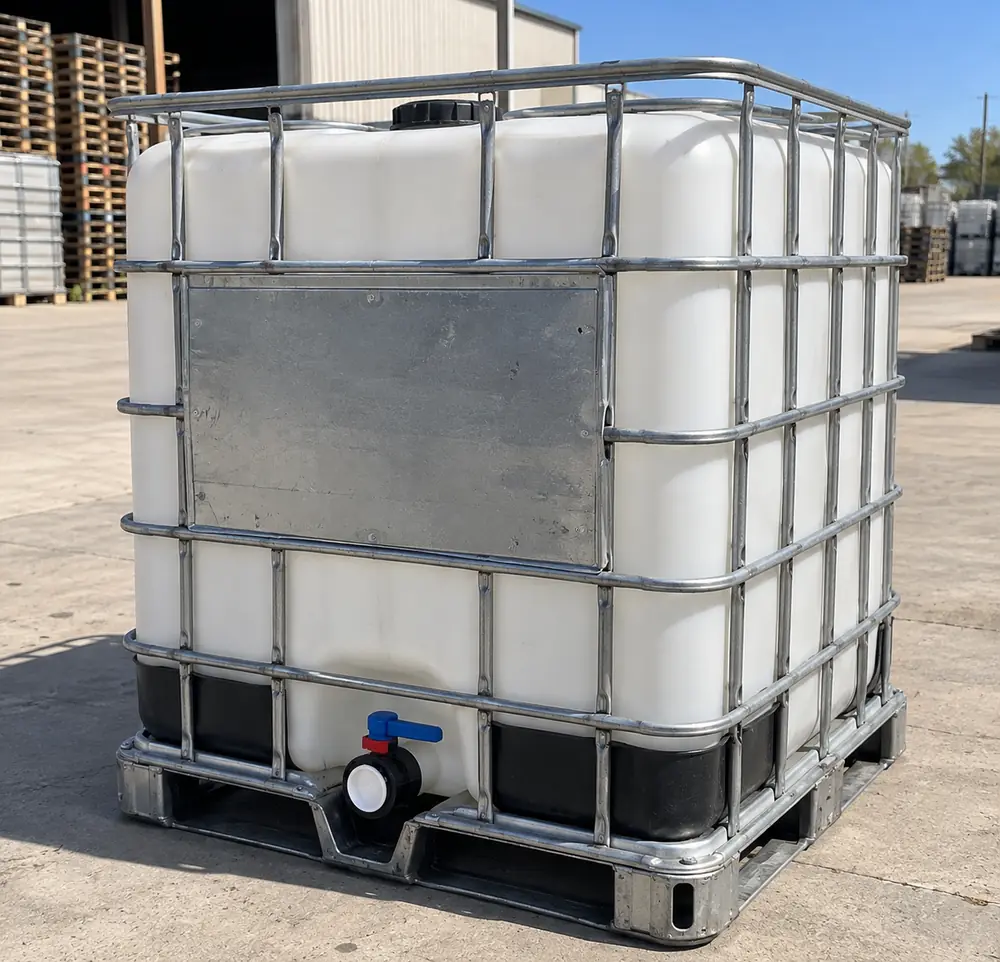
Everything in the tables, on one object
- The cage: galvanized steel tube that protects the bottle and carries the load when a tote is stacked.
- The bottle: HDPE, about 265 usable gallons of the 275 nominal, and usually the first component to wear out.
- The pallet: steel here; composite and timber also exist, and the choice affects outdoor life, pallet-jack entry and export.
- The outlet: a 2-inch valve, commonly on an S60x6 buttress thread, low on the front panel.
- The lid: a 6-inch screw closure, vented or solid. A solid lid on a pumped discharge can collapse a wall panel.